Respect PIKPA spirit – Respect humanity and dignity


A shelter that has for years been a symbol of humanity and solidarity is forced to close today

Police forces are evacuating PIKPA in Lesvos, a place that hosted thousands of vulnerable asylum seekers and refugees since 2012. They are doing it with no previous notification, on the same day that the European Court of Human Rights was about to judge on the applications for interim measures of two vulnerable cases who had asked for the suspension of their removal. They are doing it despite the fact that, throughout all its years of operation, PIKPA has provided dignified living conditions to its residents in stark contrast to reception facilities run by the state.

The widespread reaction to the Greek Government’s intention to move the people hosted in the shelter, at least, saved them from having to be moved to unacceptable conditions, like those prevailing in the new Kara Tepe hosting facility (rightly described as Moria 2.0). They will instead be moved to the old Kara Tepe, which is run by the Municipality with the assistance of UNHCR, as per the government’s announcement.[i]

However, this facility is also planned to close on 31-12-2020, according to the Ministry’s announcement,[ii] and there is no prospect of creating or preserving a proper reception facility for the most vulnerable. On the contrary, Greek and European authorities are assessing the possibility to create a new closed/controlled center in the middle of nowhere that will inter alia further hinder asylum seekers’ and refugees’ access to crucial services, such as healthcare, while further marginalizing and stigmatizing them, through their isolation them from the local community.

PIKPA’s spirit of solidarity should instead prevail: for the sake of the people that the shelter has welcomed over the years, for the sake of the local population that has for years hosted thousands or even millions of people, for the sake of dignity and humanity.

We call on the Greek authorities to:

– Respect the people hosted in PIKPA and provide them with dignified reception conditions, in line with EU law, along with protection of the most vulnerable among them

– Preserve the old Kara Tepe facility, where the special needs of vulnerable persons can be catered for and respected,

– Refrain from creating a closed reception center that will lead to even more pain to persons in a situation of vulnerability

– Respect the right of all people to organize and seek the help of civil society organizations and support initiatives, and especially those, such as LESVOS Solidarity, that are based on the spirit of solidarity and volunteerism.

Signatories

AMNESTY INTERNATIONAL

ANTIGONE – INFORMATION AND DOCUMENTATION CENTRE ON RACISM, ECOLOGY, PEACE AND NON VIOLENCE

CENTRE DIOTIMA

ECHO100PLUS

ECOLOGICAL MOVEMENT OF THESSALONIKI

FENIX- HUMANITARIAN LEGAL AID

GREEK COUNCIL FOR REFUGEES (GCR)

GREEK FORUM OF REFUGEES (GFR)

GREEK FORUM OF MIGRANTS

GREEK HOUSING NETWORK

HELLENIC LEAGUE FOR HUMAN RIGHTS

HELP REFUGEES/ CHOOSE LOVE

HIAS GREECE

HUMANRIGHTS360

INTERNATIONAL RESCUE COMMITTEE

INTERSOS HELLAS

INTERVOLVE

LEGAL CENTRE LESVOS

LESVOS SOLIDARITY

MOBILE INFO TEAM

NETWORK FOR CHILDREN’S RIGHTS

ODYSSEA

OXFAM

REFUGEE RIGHTS EUROPE (RRE)

SAFE PLACE GREECE

SOLIDARITYNOW

SYMBIOSIS-SCHOOL OF POLITICAL STUDIES IN GREECE


[i] https://migration.gov.gr/klisimo-domis-pikpa-lesvos/

[ii] https://www.ethnos.gr/ellada/125361_lesbos-kleinoyn-dyo-domes-prosfygon

Joint Statement: The Pact on Migration and Asylum: to provide a fresh start and avoid past mistakes, risky elements need to be addressed and positive aspects need to be expanded


The commitment to a more human approach to protection and the emphasis on the fact that migration is needed and positive for Europe with which the European Commission launched the Pact on Migration and Asylum is welcome. However, this rhetoric is reflected only sparsely in the related proposals. Instead of breaking with the fallacies of the EU’s previous approach and offering a fresh start, the Pact risks exacerbating the focus on externalisation, deterrence, containment and return.

This initial assessment by civil society of the legislative and non-legislative proposals is guided by the following questions:

  • Are the proposals able to guarantee in law and in practice compliance with international and EU legal standards?
  • Will they contribute to a fairer sharing of responsibility for asylum in Europe and globally?
  • Will they work in practice?

Rather than automatic sharing of responsibility, the Pact introduces a more complex Dublin system (by another name) and ‘return sponsorship’

The Pact on Migration and Asylum missed the opportunity to fundamentally reform the Dublin system and the default responsibility for assessing asylum claims remains, in practice, with the first country of arrival. In addition, a complex system in which some form of solidarity is triggered has been proposed.

There are some positive additions to the criteria used to determine which Member State is responsible for examining an asylum application. For example, an expanded definition of family to include siblings, a broad range of family members in the case of unaccompanied children and the receipt of a diploma or other qualification from a Member State. However, judging by current Member State practice, it will be a challenge to overcome the first country of entry principle as the go-to option in favour of the new priority considerations, notably family reunification.

Solidarity is required of Member States in the case of a high number of people arriving (“migratory pressure”) or disembarkations from search and rescue operations. The ensuing processes include a series of assessment and reports being drafted and pledges by individual Member States. If the aggregate response falls short, the European Commission can take corrective action. This looks less like a mechanism that supports predictable sharing of responsibility and more like the kind of negotiations among Member States with which we have all become too familiar. The complexity of what has been proposed raises doubts as to whether it is actually workable in practice.

Member States are allowed to provide “return sponsorship” instead of relocating people to their own territories, which suggests an equal focus on return to the focus on protection. Instead of supporting individual Member States managing a higher number of asylum applications, this proposal raises numerous human rights and legal concerns, especially should transfer to the so-called sponsor state take place after the deadline of 8 months has passed. Who will monitor the treatment of rejected asylum-seekers when they arrive in countries whose governments do not accept relocation?

The Pact proposes expanded use of border procedures, including increased detention

Instead of recalibrating responsibility among EU Member States, the procedural reform proposals exacerbate the pressure on Member States at the EU’s external border and countries in the Western Balkans. The Commission proposes mandatory asylum and return border procedures in certain cases, including for nationals of, or stateless residents in, countries where the average EU protection rate is below 20%. It is optional when Member States are applying Safe Third Country or Safe Country of Origin concepts. However, the Commission has previously proposed that these concepts become mandatory for Member States. NGOs reiterate the concerns about the use of Safe Third Country and First Country of Asylum concepts, which were discussed extensively between 2016 and 2019. In particular, mandatory use should not be proposed again.

The proposed border procedure is predicated on two flawed assumptions – that the majority of people arriving in Europe do not have protection needs and that assessing asylum claims can be done easily and quickly. Neither are correct. A consideration of first and appeal decisions across the EU indicates that most people claiming asylum in Europe in the last three years have received a form of protection status. In addition, the Pact should not persist with the wrongheaded approach that fast asylum procedures can be achieved by reducing safeguards and introducing a system of triage. The average length of the asylum procedure in the Netherlands, often referred to as the poster child for this practice, exceeds a year and can last up to two years until a decision has been taken.

The proposal will effectively result in two standards of asylum procedures, largely determined by the country of origin of the individual concerned. This undermines the individual right to asylum and will mean that more people are subject to a second-rate procedure. Proposing that Member States should issue an asylum and return decision simultaneously without clearly specifying the requirement that important safeguards related to non-refoulement, best interests of the child and protection of family and private life are assessed, undermines international legal obligations. The proposal also removes the automatic suspensive effect of an appeal, i.e. the right to remain pending a decision for cases decided in the border procedure.

The suggestion that people undergoing border procedures are not considered to have formally entered the territory of the Member State is misleading, contradicts recent EU jurisprudence but does not change the individual’s rights under EU and international law.

The proposal also deprives people of the possibility to access residence permits for grounds other than asylum and will likely involve detention for up to 6 months at the EU’s borders, a maximum of 12 weeks for the asylum border procedure and another 12 weeks in case of a return border procedure. In addition, the reforms remove the principle that detention should only be applied as a measure of last resort in the context of border procedures. By relying on more systematic restrictions of movement in border procedures, the proposal will restrict the individual’s access to basic services provided by actors who may not operate at the border, including for legal assistance and representation. The similarities in outcomes to the failed ‘hotspot approach’ implemented on the Greek islands are notable.

The recognition that the best interest of the child shall be a primary consideration for Member states with respect to all procedures is positive. However, the Commission lowers the protection standards for children, only exempting those who are unaccompanied or under the age of twelve from border procedures. This is in contradiction with the internationally recognised definition of children as every person until the age of eighteen, included in the Convention on the Rights of a Child, ratified by all EU Member States.

In situations of crisis, Member States are allowed to derogate from important safeguards which will subject more people to substandard asylum procedures

The concern about procedural unfairness becomes even more acute in situations where a Member State can claim that they are facing an ‘exceptional situation of mass influx’ or even the risk of such a situation.

When this occurs, the scope of the border procedure is significantly expanded and can be applied to all people arriving from countries where the average EU protection rate of the nationality concerned is below 75%. Both the asylum border procedure and the return border procedure can be extended for an additional eight weeks so five months each, prolonging the maximum amount of time spent in border detention to 10 months. In addition, Member States can suspend registration of asylum applications for four weeks and up to a maximum of three months. With no claim registered for weeks, people may be at risk of detention, refoulement and their rights to adequate reception and basic services can be severely affected.

This enables Member States to derogate from their responsibility to provide access to asylum and ensure that peoples’ asylum requests are treated efficiently and fairly, and thus increases the risk of refoulement. From the perspective of the most extreme case of Member States acting in flagrant and persistent violation of EU law obligations, this process of requesting permission from the European Commission could be considered an improvement because currently the law is ignored without consultation of and despite criticism by the European Commission. However, this cannot be the starting point to assess proposed EU legislation. The broader impact of this will be that it opens up the possibility that the vast majority of people arriving in Europe will be subject to a second-rate procedure.

Screening at the border: risks and opportunities

The Commission proposes a “pre-entry screening” process for all people who arrive at EU borders irregularly, including following disembarkation after search and rescue. The screening process includes security, health and vulnerability checks, and registration of biometric data but it also leads to decisions which relate to access to asylum including whether to apply the accelerated border procedure, relocation and return. This process can take up to 10 days, and should be carried out as close as possible to the border. Where people will be accommodated and how reception standards will be met during that time is not clear. The screening can also be applied to people inside the territory of a Member State, which could lead to an increase in discriminatory policing. Questions arise regarding access to information, the rights of people undergoing the screening, including access to a lawyer and the right to challenge the decision; the grounds for refusal of entry; and the privacy and protection of the data collected. As Member States can easily discharge their responsibilities regarding medical and vulnerability screenings, it is not clear whether related needs will be detected and acted upon.

A welcome initiative is the proposed independent monitoring of fundamental rights at the border. To ensure that this mechanism results in accountability for rights violations at the border, including the persistent use of summary removals and push-backs across a large number of Member States, it needs to be expanded beyond the screening procedure, be independent of national authorities, and involve independent organisations such as NGOs.

The priority of return and deportation dominates the proposal  

The overriding objective of the Pact is clear: an increase in the number of people who are returned or deported from Europe. The creation of the role of a Return Coordinator within the Commission and of a Frontex Deputy Executive Director on Returns without similar appointments on protection standards or relocation illustrate this point. Return is an accepted part of migration policy and support for dignified returns, with a preference for voluntary returns, access to return counselling, and reintegration support is important. However, investment in return is not the answer to the systematic non-compliance with asylum standards in EU Member States.

Nothing new on external action: unrealistic proposals which risk undermining human rights continue

The tension between the rhetorical commitment to mutually beneficial international partnerships and the insistence on migration being at the core of the EU’s relationships with third countries continues. Attempts to externalise responsibility for asylum, and to mis-use development assistance, visa schemes and other tools to pressure third countries to cooperate on migration control and readmission agreements will continue. This not only risks contradicting the EU’s own commitment to development principles, but also undermining its international standing by generating mistrust and hostility from and among third countries. Furthermore, using informal agreements and security cooperation for migration control with countries such as Libya or Turkey risks enabling human rights abuses, emboldening repressive governments and creating greater instability.

Lack of ambition on safe and regular pathways to Europe

An opportunity to signal that the EU is ready to contribute to responsibility sharing for protection on the international stage in the spirit of partnership with countries who are hosting the large majority of refugees was missed. Instead of proposing an ambitious refugee resettlement target, the European Commission has only invited Member States to do more and has converted Member State pledges for 2020 into a two-year scheme, resulting in a lost year for EU resettlement.

The recognition of the need to facilitate more labour migration across skills levels is welcome but the significance of labour migration for European economies and societies is not reflected in the related resources, proposals or actions.

Support to search and rescue and actions of solidarity need to be reinforced

The humanitarian tragedy in the Mediterranean Sea still needs to be addressed, including for example through EU-funded and run search and rescue capacity. Search and rescue and disembarkation are included in all relevant proposals, acknowledging that there is an ongoing humanitarian crisis. However, instead of addressing the behaviour and regulations of governments to obstruct sea rescues and enabling the work of human rights defenders, the European Commission suggests that safety standards on ships and communication levels with private actors need to be monitored. It also appears to require private actors to adhere not just to laws, but also policies and practices regarding “migration management” which can potentially interfere with search and rescue obligations.

While the issuance of guidance to prevent criminalisation of humanitarian action is welcome, this is limited to acts mandated by law with a specific focus on search and rescue. This risks leaving out humanitarian activities such as the provision of food, shelter or information conducted on land or carried out by organisations not mandated by law which are also subject to criminalisation and restrictions.

Promising signs for inclusion

Proposed changes that would enable refugees to gain long-term residence after three years and strengthen the right to move and work in other Member States are positive. In addition, the revision of the Action Plan on Inclusion and Integration and the establishment of an expert group to collect views of migrants to inform EU policy is welcome. 

The way ahead

The presentation of the proposals is a start to what promises to be another long and conflictual period of negotiations on the EU’s asylum and migration rules. While those negotiations are ongoing, it is important to recall that there is an EU asylum framework in place and that Member States have obligations under existing international and EU law.

This requires immediate action by EU policy makers, including Member States, to:

  • Implement existing standards in relation to reception and asylum processes, investigate non-compliance and take necessary disciplinary measures;
  • Save lives at sea, ensuring search and rescue capacity, allowing timely disembarkation and swift relocation;
  • Continue to seek ad-hoc solidarity arrangements to alleviate pressure on Member States at the EU’s external border and support Member States to agree to relocation.

For the upcoming negotiations on the Pact, we recommend that co-legislators:

  • Reject the mandatory application of asylum or return border procedures: they are substandard procedures which reduce safeguards for applicants and increase detention. They will exacerbate the current lack of solidarity for asylum in Europe by placing more responsibility on Member States at the external border. Experience from the hotspots and similar initiatives shows that adding extra asylum procedures or tracks can create significant administrative burden and costs, and generate more inefficiency;
  • Work towards the end of migration-related detention, prohibit migration-related detention of children as per the Convention on the Rights of the Child and dedicate sufficient resources to appropriate non-custodial solutions for children and their families;
  • Recalibrate reform proposals to focus on maintaining and raising asylum and human rights standards in Europe, rather than return;
  • Work towards proposals that fundamentally reform the way in which responsibility for people seeking asylum in Europe is organised, addressing the first country of entry principle, in order to create meaningful and predictable mechanisms for solidarity;
  • Limit possibilities for Member States to derogate from responsibilities to register asylum applications or process asylum claims in order to avoid creating incentives for operating in crisis mode and for lowering asylum standards;
  • Increase the safeguards during the screening procedure to ensure information is provided; access to a lawyer is ensured; health needs and vulnerabilities are detected and swiftly acted upon; and address concerns regarding registration and sharing of biometric data;
  • Ensure that the monitoring mechanism for fundamental rights at borders is broad in scope to cover all fundamental rights violations at the border, truly independent from national authorities, well-resourced and that it contributes to accountability;
  • Resist attempts to use development assistance, trade, investment, visa schemes, security cooperation and other policies and funding to pressure third countries into cooperation on narrowly defined EU migration control objectives;
  • Evaluate the long-term impact of externalised migration policies on peace, rights and sustainable development and ensure that external migration policy is not contributing to human rights violations and is conflict sensitive;
  • Significantly expand safe and regular routes to Europe by swiftly implementing current resettlement commitments, proposing ambitious new targets and increasing opportunities for protection pathways as well as for regular migration to work and study in Europe;
  • Strengthen the exemptions of humanitarian action and other independent civil society activities from criminalisation and remove obstacles to civil society actors providing life-saving and other humanitarian assistance on land and at sea;
  • Establish an EU-funded and run Search and Rescue Operation in the Mediterranean Sea;
  • Build on the promising proposals to support inclusion through access to long-term residence and related rights and by implementing the upcoming Action Plan on Integration and Inclusion at the EU, national and local level.

Signatories:

11.11.11
AASIA
ActionAid Denmark
ActionAid Hellas
ActionAid International
ActionAid Italy
aditus foundation
Afghan Association in Sweden
Alianza por la Solidaridad-ActionAid Spain
Amnesty International
ASGI
Association for Legal Intervention (Stowarzyszenie Interwencji Prawnej), Poland
AsyLex
Asylrättscentrum/ Swedish Refugee Law Center
AWO Bundesverband
Belgrade Centre for Human Rights
Bhutan Watch
Bulgarian Helsinki Committee
Caritas Cyprus
Caritas Europa
Centre for Peace Studies Zagreb
COMPASS for Refugee Youth
Conselho Português para os Refugiados – CPR (Portuguese Refugee Council)
Cyprus Refugee Council
Danish Refugee Council (DRC)
Der Paritätische Gesamtverband
Deutscher Caritasverband
Diakonie Austria
Diakonie Deutschland
Dignity
Dutch Council for Refugees
ECRE
Estonian Refugee Council
Europe Must Act
European Evangelical Alliance
FARR, the Swedish Network of Refugee Support Groups
Finnish Refugee Advice Centre
FOCSIV, Italian Federation Christian organisations international volunteering service
Forum réfugiés-COSI
Foundation Our Choice, Poland
Fundacja Polskie Forum Migracyjne/ Polish Migration Forum Foundation
Greek Council for Refugees
Group 484
Help Refugees/ Choose Love
Helsinki Foundation for Human Rights
HIAS Greece
Homo Faber Association
Hrvatski pravni centar/Croatian Law Centre
Human Rights Watch
Hungarian Helsinki Committee
ICMC Europe
International Centre for Eritrean Refugees and Asylum Seekers -ICERAS
International Rescue Committee (IRC)
INTERSOS
Irish Refugee Council
Issues Without Borders
Italian Council for Refugees/Consiglio Italiano per i Rifugiati-onlus
JRS Europe
Legal – Informational Centre for NGOs – PIC, Slovenia
Lesvos Solidarity
Mosaico azioni per i rifugiati
Network for Children’s Rights (Greece)
NOMADA Association for Multicultural Society Integration
Norwegian Organisation for Asylum Seekers (NOAS)
Norwegian Refugee Council (NRC)
Pro Asyl
Quaker Council for European Affairs
Refugee Party
Refugee Rights Europe (RRE)
Refugees International
Saferworld
SB Overseas
SCI Hellas
Solidarity Now
SOS Children’s Villages International
SPEAK
Swiss Refugee Council
Symbiosis-School of Political Studies in Greece
The International Rehabilitation Council for Torture Victims
The Swedish Syrian Association
United Against Inhumanity (UAI)
Vluchtelingenwerk Vlaanderen
vzw NANSEN asbl
World Refugee & Migration Council

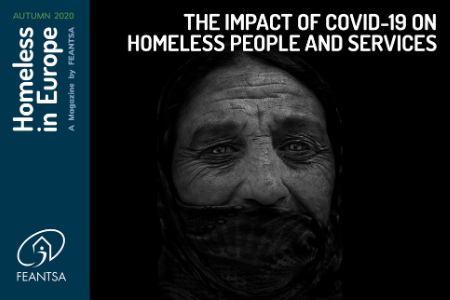
FEANTSA Homeless in Europe


The Autumn 2020 issue of @FEANTSA’s Homeless in Europe Magazine is now available!

This issue is full of interesting articles about the impact of #covid19 on #homeless #migrants, #LGBTQ youth and more, including a piece by our own Advocacy Officer, Dominika Spyratou, about how Covid-19 has highlighted the anti-migration agenda in Greece.

Read it here

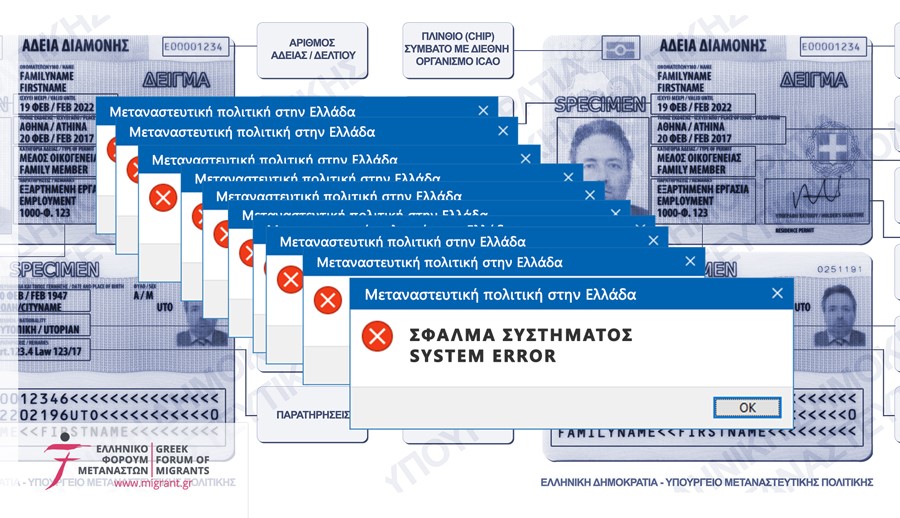
Legal, but without a residence permit


The measures taken by the Ministry of Migration and Asylum in order to extend the validity of residence permits have already created a huge problem for the entire migrant population in Greece.

Although the Ministry of Migration and Asylum has issued an extension of the residence permits (from March until December 31, 2020), the complaints for non-recognition of this extension from other Ministries, Municipalities or competent citizen service providers are gradually rising. For example, there are currently people who could take the oath for naturalization, and instead the authorities do not accept the extension of their residence permit and are not allowed to do so.

In addition, although the decentralized services started their reopening only after a scheduled appointment, these appointments are taking too long to be scheduled.

Also, the delayed operation of the online platform without proper instructions – steps that must be followed by those interested-, led to additional delays in the renewal or issuance of residence permits.

Decentralized services operate without a central organization and with reduced staff, as a result each one of them applies a different mode of operation and passes on to migrants any bureaucratic problems that appear.

All of the above leave the migrants exposed, creating the false impression that they have expired residence permits, that they are irregular.

We find it unacceptable that, once again, migrants are treated as second-class citizens. These people were called and met the obligations set by the Greek state, without response. We demand from the Greek state to do the obvious and to solve the issues that have arisen immediately.

The signatory organizations:

Greek Forum of Migrants, Greek Forum of Refugees, Solidarity Now

Racist Violence Recording Network: Justice shields the rule of law and human rights in Greece


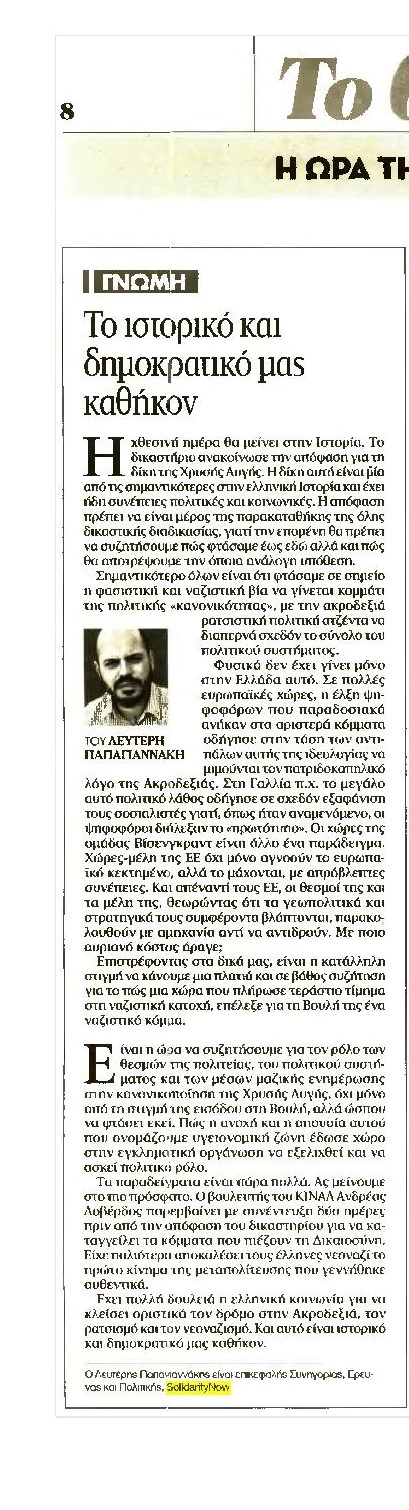
The trial of the Golden Dawn case is going to be completed soon, after a lengthy process of almost six years, while the Court has ruled unanimously that Golden Dawn was set up and operated as a criminal organization and found guilty the majority of those accused of a number of criminal acts.

The Racist Violence Recording Network (RVRN) and its 47 member organizations welcome this landmark decision, which shields in practice the rule of law in Greece and sends a clear message condemning the criminal activity of Golden Dawn. RVRN also commends the key contribution and persistence shown by the victims, their families and their lawyers, as well as by all those who participated, consistently and decisively, in the solidarity network that supported the victims and the witnesses in this long pathway to justice.

The Racist Violence Recording Network has been following with great interest the Golden Dawn trial, to which it has been summoned to testify on behalf of the legal team of the “Egyptian fishermen case” – one of 154 incidents that RVRN recorded in 2012. Since its establishment in 2011, RVRN has repeatedly sounded the alarm over the dramatic increase of the racist attacks as well as the way they were carried out (modus operandi). It is reminded that a determining factor for the RVRN establishment was – to a large extent – the decision by the representatives of civil society actors and communities of the victims, to urgently respond in a coordinated manner to the needs resulting from the organized activity of Golden Dawn. These actors, under the coordination of the National Commission for Human Rights and UNHCR, the UN Refugee Agency, set up the RVRN in 2011, with the aim to document the increase in racist attacks and organized xenophobic violence as well as to advocate for the necessary changes aiming at putting an end to the climate of impunity that had been cultivated for a long time. Today, all five defendants in the case of the Egyptian Fishermen were found guilty, restoring a sense of security and justice both for the victims and the communities they belong to, as well as for the whole of society.

It should be noted, however, that there is no room for complacency. Although, according to the RVRN records, incidents of organized violence have decreased since 2013, it continues to record attacks with features of a structured organization or committed by organized groups, as it has been also documented in its last annual report for 2019. RVRN also notices a growing trend in the racist violence incidents in various aspects of everyday life both against refugees and migrants, as well as against LGBTQI individuals. At the same time, attacks against human rights defenders remain an issue of concern.

As RVRN has repeatedly stated in the past, the rise of these incidents is inextricably linked to the institutional racist rhetoric through the public discourse used by some political leaders, at the central and local level, and the media, which significantly contributes to the normalization of xenophobia and intolerance. RVRN has been calling on State and local government representatives, as well as media representatives, to refrain from the racist rhetoric that encourages xenophobic reactions and affects social peace and cohesion.

Lastly, the court decision reminds us that the fight against racism and racist violence and the legal response to violent xenophobic groups is a matter of respect for human rights and the rule of law. The effect of the sentence against Golden Dawn constitutes in practice a form of protection to every individual who is different, and every community member targeted on racist, xenophobic, homophobic or transphobic motivation. May this decision be an additional reason to remind that no hate crime, motivated solely or cumulatively by hatred or bias, should remain unpunished.

Protect dignity and human rights: call for solidarity gathering in support of PIKPA on Wednesday, 14 October 2020.


The Greek government is about to close a historic shelter for vulnerable asylum seekers and refugees, with no care for the future of its residents. The Secretary General of Social Solidarity and Poverty Alleviation of the Ministry of Labor and Social Affairs asked the Police to evacuate the PIKPA Shelter in Neapoli Mytilene until 15-10-2020.

PIKPA shelter is a well-known facility operating since 2012. At the time, it was the only open reception facility on the island, in stark contrast to Moria camp, which operated as a Detention Centre.  For years, many actors have come together at the PIKPA shelter to support some of the most vulnerable people in the island, including Lesvos Solidarity, founded in 2016. As also highlighted in UNHCR’s recent announcement in support of PIKPA,[1] Efi Latsoudi, one of the founders, was awarded the UNHCR Nansen Award in Geneva, in 2016.

PIKPA currently hosts 94 highly vulnerable persons (unaccompanied minors, victims of torture, severely handicapped persons, persons with serious illnesses) who have been referred there for accommodation by the competent state authorities (Public Prosecutor for the unaccompanied minors and Reception and Identification Service in collaboration with UNHCR for the rest of the cases).

Characterising PIKPA an “illegally squatted” facility, as was done by the Ministry of Labor and Social Affairs in the letter calling for the facility’s evacuation,[2] lacks any grounding.

One month after the fire in Moria, which once more accentuated the squalid conditions under which asylum seekers are hosted on the Greek islands, the first rain proved the inadequacy of the temporary facility in which Moria’s displaced asylum seekers and refugees were transferred to. Particularly amid these circumstances and the COVID-19 pandemic, the evacuation of one of the most humane facilities in Greece and particularly the Greek islands seems to lack reasoning and humaneness and is directly at odds with Greece and the EU’s obligation to respect human rights and provide proper reception conditions to asylum seekers, particularly the most vulnerable.

In solidarity with refugees and the organizations that strive to assist them even under the most deplorable conditions, especially on the Greek islands, we call on the Greek authorities to reconsider the order to evacuate PIKPA.

On Wednesday, 14-10-2020, we will stand by Pikpa in defense of the humanity and dignity that everyone deserves. We call on everyone supporting humanity and dignity to join us in solidarity at PIKPA camp on Wednesday 14 October at 10:00am.*

*We respect hygiene measures and those most vulnerable amongst us. We wear a mask and keep social distancing measures.

Signatories

  • ANTIGONE – Information and Documentation Centre on Racism, Ecology, Peace and Non Violence
  • Changemakers Lab
  • CRWI Diotima
  • Ecological Movement of Thessaloniki
  • Europe Must Act
  • Fenix – Humanitarian Legal Aid
  • Greek Council for Refugees (GCR)
  • Greek Forum of Migrants
  • Greek Housing Network
  • Hellenic League for Human Rights (HlHR)
  • Help Refugees/Choose Love
  • HIAS Ελλάδος
  • HumanRights360
  • INTERSOS Hellas
  • InterVolve
  • Legal Centre Lesvos
  • Médecins Sans Frontières (MsF)
  • METAdrasi
  • Mobile Info Team
  • Network for Children’s Rights
  • Odyssea
  • SolidarityNow
  • Symbiosis-School of Political Studies in Greece
  • Terre des hommes Hellas

[1] https://www.unhcr.org/gr/16647-month-moria-fires-unhcr-warns-worsening-conditions-ahead-winter.html

[2] https://stonisi.gr/post/11720/ekkenwste-to-pikpa-ews-tis-15-oktwvrioy

Greece: Investigate Pushbacks, Violence at Borders


Groups Press Parliament to Open Inquiry

Members of Greece’s parliament should urgently establish an inquiry into all allegations of unlawful returns of migrants to Turkey by law enforcement officers and others, 29 human rights and humanitarian aid organizations said in an open letter released today. These returns are carried out mainly through pushbacks and collective expulsions and are often accompanied by violence.

Parliament should exercise its oversight authority to investigate the allegations of these illegal acts by state agents and proxies on Greece’s sea and land borders with Turkey. The parliament’s inquiry should examine whether any illegal acts identified are part of a de facto government policy at odds with international, European, and Greek law.

Over the years, nongovernmental groups and media outlets have consistently reported the unlawful return, including through pushbacks, of groups and individuals from Greece to Turkey by Greek law enforcement officers or unidentified masked men, who appear to be working in tandem with border enforcement officials.

Reports from 2020 recorded multiple incidents in which Greek Coast Guard personnel, sometimes accompanied by armed masked men in dark clothing, unlawfully abandoned migrants – including those who had reached Greek territory. They abandoned the migrants at sea, on inflatable vessels without motors; towed migrant boats to Turkish waters; or intercepted, attacked, and disabled boats carrying migrants.

Nongovernmental organizations and the media have also reported persistent allegations that Greek border guards have engaged in collective expulsions and pushbacks of asylum seekers through the Evros land border with Turkey.

On June 10, the International Organization for Migration (IOM) said it was “closely monitoring” the situation at the Greek border and reported receiving “persistent reports” of migrants being arbitrarily arrested in Greece and pushed back to Turkey. The IOM said that Greece should investigate.

On August 21, the United Nations High Commissioner for Refugees (UNHCR) said it was “deeply concerned by an increasing number of credible reports indicating that men, women, and children may have been informally returned to Turkey immediately after reaching Greek soil or territorial waters in recent months,” and urged Greece to refrain from such practices and to seriously investigate these reports. The agency had released a statement making similar calls on June 12.

On July 6, during a debate at the European Parliament’s Committee on Civil Liberties, Justice and Home Affairs (LIBE) on fundamental rights at the Greek border, the European Commissioner for Home Affairs, Ylva Johansson, said those incidents should be investigated. In its new Pact on Migration and Asylum, presented on September 23, the European Commission recommended to member states to set up an independent monitoring mechanism, amid increased allegations of abuse at the EU’s external borders. But no such system has been instituted.

Confronted during a CNN interview with an August 14  New York Times article documenting pushbacks, Prime Minister Kyriakos Mitsotakis said: “It has not happened. We’ve been the victims of a significant misinformation campaign,” suggesting instead that Turkey was responsible.

Greek lawmakers should conduct a prompt, effective, transparent, and impartial investigation into allegations that Greek Coast Guard, Greek police, and Greek army personnel, sometimes in close coordination with uniformed masked men, have been involved in acts that not only violate the law but put the lives and safety of displaced people at risk.

Any officer found to have engaged in such illegal acts, as well as their commanding officers and officials who have command responsibility over such forces, should be subject to disciplinary and criminal sanctions, as applicable. The investigation should seek to establish the identity and relationship of the masked men and other unidentified officers to law enforcement and take steps to hold them to account. The investigation should cover events surfaced in 2019 and 2020, the groups said.

The following quotes may be attributed to members of the groups involved:

“Despite government denials, over the years many witnesses and victims have told us about pushbacks from land and sea that put migrants’ lives at risk,” said Eva Cossé, Greece researcher at Human Rights Watch. “Parliament should step up now and do all it can to put an end to this life-threatening practice.”

“The continued failure to address the serious allegations of pushbacks and violence against people on the move at Greece’s borders can no longer be tolerated,” said Adriana Tidona, migration researcher at Amnesty International. “We call on the Greek parliament to exercise its powers in the interest of all those who have been harmed by these actions and to ensure that there is no repetition.”

“Over the years, we have filed a score of complaints about or related to pushbacks at Greece’s borders, including deaths, that Greek prosecutors seem to ignore,” said Panayote Dimitras, spokesperson for the Greek Helsinki Monitor. “Greece needs to act quickly to set up an independent border monitoring mechanism to investigate violations, as proposed by the European Commission, and end these abuses once and for all.”

“The right to seek asylum must be upheld at all times,” said Josie Naughton, chief executive officer of Help Refugees. “The Greek parliament should urgently conduct an inquiry to examine the well-documented and illegal practices of pushbacks and mass expulsion, which endanger the lives of men, women, and children seeking asylum in Greece.”

“We have documented the pushback of more than 1,150 asylum seekers from Greek territory in the past three months alone,” said Natalie Gruber, spokesperson for Josoor. “These are not isolated incidents but systematic violations of national, EU, and international law that the parliament cannot shrug off as fake news anymore.”

“Greek authorities are systematically expelling migrants, including those who have reached Greek territory, and abandoning them in open water,” said Amelia Cooper from Legal Centre Lesvos. “The Greek parliament should not only open an investigation of these events, but must also decree and enforce – immediately – the cessation of illegal collective expulsions at all Greek borders.”

“In order to break with the current failures to hold member states like Greece accountable for their pushbacks and rights violations at borders, the European Commission must step up its efforts and quickly put in place an appropriate monitoring mechanism,” said Marta Welander, executive director at Refugee Rights Europe. “Such efforts must also involve civil society, NGOs, and national human rights institutions to ensure that available evidence is taken seriously and leads to timely investigation and redress.”

“The protection of the borders, of vital importance in itself, can be in compliance with international law and human rights standards,” said Antigone Lyberaki, SolidarityNow’s general manager. “The Greek parliament has both the means and a constitutional obligation to oversee and investigate the alleged infringement of international human rights obligations by the Greek state.”

“As a child protection organization, Tdh Hellas is particularly worried about the fact that among those reported to have been violently expelled across EU borders are children, including babies,” said Melina Spathari of Terre des hommes Hellas. “The Greek government should stop such acts and try instead to address the chronic gaps in the reception and protection system for families and unaccompanied children.”

Signatories:

  • Human Rights Watch
  • ActionAid Hellas
  • Amnesty International
  • ARSIS – Association for the Social Support of Youth
  • Danish Refugee Council
  • Equal Rights Beyond Borders
  • Fenix – Humanitarian Legal Aid
  • Greek Council for Refugees
  • Greek Forum of Refugees
  • Greek Helsinki Monitor
  • Hellenic League for Human Rights
  • Help Refugees
  • HIAS Greece
  • HumanRights360
  • International Rescue Committee
  • INTERSOS Hellas
  • Josoor
  • Legal Centre Lesvos
  • Lesvos Solidarity
  • Medecins Du Monde – Greece
  • Mobile Info Team

Network for Children’s Rights

PRAKSIS

Refugee Legal Support

Refugee Rights Europe

Refugees International

Refugee Support Aegean

SolidarityNow

Terre des hommes Hellas


PUBLIC STATEMENT: SAVE DIGNITY, SAVE PIKPA AND KARA TEPE


Μore than 160 Greek and international organizations,  academics and other actors from all over Europe urge the Greek authorities to revoke decision to close dignified alternatives in accommodating refugees οn Lesvos

Athens, 30 September 2020 – We, the undersigned, call on the Minister of Migration and Asylum, Notis Mitarakis, and the local authorities of Lesvos to repeal their decision to terminate the operations of PIKPA and Kara Tepe facilities for vulnerable asylum seekers on the island of Lesvos. The authorities should not only revoke the decision to shut down these facilities, but in this time of great need, they should further strengthen and protect all dignified alternative solutions for asylum seekers’ housing and protection.In the last five years, PIKPA and Kara Tepe have sheltered vulnerable people escaping from the deplorable living conditions in the Reception and Identification Center (RIC) of Moria, a dangerous place where residents’ health and safety was continuously in jeopardy. The decision to shut down these facilities comes only a few days after a devastating series of blazes burned camp Moria to the ground, leaving more than 12.000 women, men and children with no access to shelter, food and water.

While a new “emergency” camp has been set up on the island, which is currently hosting former residents of Moria camp, many of the signatories present on the ground report significant gaps in protection, access to electricity, water supply and sanitation, safety and security. For as long as the conditions in the RICs are undignified for human beings, alternative responses will be needed, to protect the most vulnerable. PIKPA and Kara Tepe should now by all means continue to offer accommodation and protection solutions that are appropriate, especially for the most vulnerable, including unaccompanied and separated children, single mothers, victims of torture and ill treatment, male and female survivors of gender-based and sexual violence, and people with disabilities.

PIKPA, an open, self-organised solidarity space, has provided essential services and assistance to refugees on Lesvos since 2012. In 2016, the United Nations High Commissioner for Refugees (UNHCR), awarded the Nansen Refugee Award to one of the co-founders of PIKPA, in recognition of their work saving lives and providing a safe haven for the most vulnerable during the refugee ‘crisis’ in 2015. Today, PIKPA hosts unaccompanied children, single mothers and persons that have suffered torture or ill treatment, as well as many people with heightened vulnerabilities. Survivors of torture and ill treatment suffer from chronic physical pain for years after their abuse, and psychological symptoms such as anxiety, depression, withdrawal and self-isolation, post traumatic stress, known as PTSD etc. PIKPA offers a dignified and safe space for the survivors who would otherwise be continuously re-traumatized in an unsafe environment.

Kara Tepe has been run by the municipality with a capacity of more than 1,000 people. It has offered humane living conditions to vulnerable asylum seekers and families that were transferred there from Moria, including single parents, people with disabilities, and many families with health problems. It has been lauded for its infrastructure and community-like atmosphere.

While it is unclear where current residents of PIKPA and Kara Tepe will be transferred, the undersigned are convinced that going to the new “emergency” camp would endanger their physical and mental health and should be avoided at all costs. In addition, PIKPA and Kara Tepe could actually take in and better provide for the individuals who are more “at-risk” currently residing in the new Lesvos RIC. This would be especially important for people with disabilities, for example, as there are no accessible latrines in the new RIC at this time.

We urge Greece’s national and local authorities:

To immediately halt the closure of PIKPA and Kara Tepe and to support and further enhance their outstanding contributions.  At the same time the authorities should seek solutions in line with human rights standards for the operation of the new temporary camp in Lesvos, pursuing the ultimate goal of its steady decongestion, and providing adequate standards in terms of  safety, water, sanitation and medical assistance to all residents, until all are moved to safer and dignified accommodation conditions”.

The signatories:

A Buon Diritto Onlus

ActionAid Hellas

Agir pour la paix

Aid Brigade

AITIMA

Amnesty International

Anders Wachsen

ANTIGONE – Information and Documentation Centre on Racism, Ecology, Peace and Non Violence

Are You Syrious (AYS)

ARSIS – Association for the Social Support of Youth

Asociacion Pro Derechos Humanos de Andalucia  (APDHA)

Asociación SINGA España

Association européenne de défense des droits de l’Homme (AEDH)

Babel Day Centre

Basta Violenza alle Frontiere

Be a Robin

Better Days

borderline-europe e.V.

Calais Action Brighton

Casetta Rossa

Catch a Smile asbl

Centre Avec asbl

Centre de formation Bienenberg

Changemakers Lab

Choosehumanity

Chorleywood4Refugees

Christian Peacemaker Teams

Christian Peacemaker Teams Netherlands

Church and Peace

Coexistence and Communication in the Aegean

Collectif de soutien de l’EHESS aux sans-papiers et aux migrant-es

Collectif pour une terre plus humaine

Collective Aid

Comité de Solidarité avec le Peuple Grèce de Lyon

Coordindora de Barrios

CPT – Aegean Migrant Solidarity

CRIBS International

CRID – Centre de recherche et d’information pour le développement

Diotima

Danish Refugee Council (DRC)

Defence for Children International

Defence for Children International – Italy

Defence for Children International – Netherlands

Defence for Children International Greece

Defensa de Niñas y Niños – Internacional , DNI España

Défense des enfants International Belgique

Député Wallon (Belgique)

Destination Unknown campaign

Distribute Aid

Doctors Worldwide

Donate4Refugees

ECHO for Refugees

ECHO100PLUS

Ecological Movement of Thessaloniki

European Institute for Progressive Cultural Policies

ELIX – Conservation Volunteers Greece

ENAR – European Network Against Racism

ENOUGH IS ENOUGH – rehabilitate Human Dignity

European Women’s Lobby

Everyday, just a smile

Fenix – Humanitarian Legal Aid

Firetree Philanthropy

Firetree Trust

Fondation Danielle Mitterrand

foodKIND

FORGE for humanity

Fresh Response

Friends Of Refugees

German Mennonite Peace Committee

Glocal Roots

Greek Council for Refugees

Greek Helsinki Monitor

Griechenland Solidaritätskomitee Köln

Heimatstern e.V.

Hello My Friend

Help Refugees / Choose Love

Herts for Refugees

HIAS Greece

HIGGS

Hoffnung leben e.V., Bonn, Deutschland

Hope and Aid Direct

HuBB – Humans Before Borders

Human Rights Watch

Humanitas, Centre for Global Education and Cooperation

Humanity Now

HumanRights360

Initiative for an alternative mental health

Initiative for the Detainees’ Rights

InterEuropean Human Aid Association

International Centre for Refugees ICERAS

International Federation of Social Workers, European Region (IFSW Europe)

International Rescue Committee

INTERSOS

InterVolve

Iride

Jelscha Dietrich

Jesuit Refugee Service Greece

Khora Community Centre

La Luna Di Vasilika ONLUS

Latitude Adjustment Podcast

Le Paria

Legal Centre Lesvos

Lesvos Solidarity

Love Welcomes

Make Mothers Matter

MAMbrella

Medecins du Monde/ Greece

Medecins Sans Frontieres -Doctors Without Borders -MSF

Medico International

Melissa: Network of Migrant Women in Greece

Mennonite Mission Network

Mennonitisches Friedenszentrum Berlin/Mennonite Peace Center Berlin

Migrant Voice

Migrations Libres

MiGreat

Mαζί/Together/معاً

Network for Children’s Rights

One Family-No Borders

One Happy Family

ONGD CEPAC-IB

Open Cultural Center

Organization Earth

Owl’s Watch

Pampiraiki Support Initiative for Refugees & Migrants

Parroquia San Carlos Borromeo

Peaceful Borders

People in motion

Pluspunt Netherlands

Project Armonia

Protestant Association for Conscientious Objectors and Peace (EAK), Germany

Rechtsanwältin

Refugee Aid Network Uk

Refugee Compassion

Refugee Education And Learning International

Refugee Law Clinic Berlin e.V.

Refugee Rescue

Refugee Support Aegean ( R.S.A.)

Refugee Support Europe

Refugee Trauma Initiative

Refugee Youth Service

Refugees International

REFUGYM

RefuNet

Reseau Foi & Justice Afrique Europe Antenne France

Respekt für Griechenland e.V.

Rethinking Refugees – Knowledge and Action

Safe Passage UK

SAO Association for displaced women

Seebruecke Wuppertal

ShowerPower Foundation

Side by Side Refugees

SolidarityNow

Still I Rise

Stop Precarite

Support Art Workers (Greece)

Symbiosis-School of Political Studies in Greece

Terre des hommes Hellas

Thalassa of Solidarity

Vasilika Moon

Velos Youth

Verein FAIR

Voice Of Ezidis

Wiltshire For Refugees

Yoga and Sport For Refugees

Youth for Refugees

Youth organization “Protests”


Also endorsed by:

  • dr. Ilse Derluyn, Centre for the Social Study of Migration and Refugees (CESSMIR), Department of Social Work and Social Pedagogy


  • Vassilis Pavlopoulos , Associate Professor of Cross-Cultural Psychology – National and Kapodistrian University of Athens


  • Antonello D’Elia, Presidente di Società Italiana di Psichiatria Democratica Onlus


  • Hellen Gerolymatos McDonald, Licensed Clinical Social Worker, MSW, Clinical Associate Professor, University of Illinois, Urbana-Champaign, School of Social Work, U.S.A (The opinions are Hellen McDonald’s and not those of the University of Illinois)


  • Luciano Rondine, Settore immigrazione e inclusione sociale, Centro di prevenzione psicosociale Nodo Sankara


  • Joanna Kato, chair of Human Rights & Social Responsibility Committee of the European Association for Gestalt Therapy (EAGT)


  • Athina Fragkouli, President of the Board of the Society of Social Psychiatry P. Sakellaropoulos