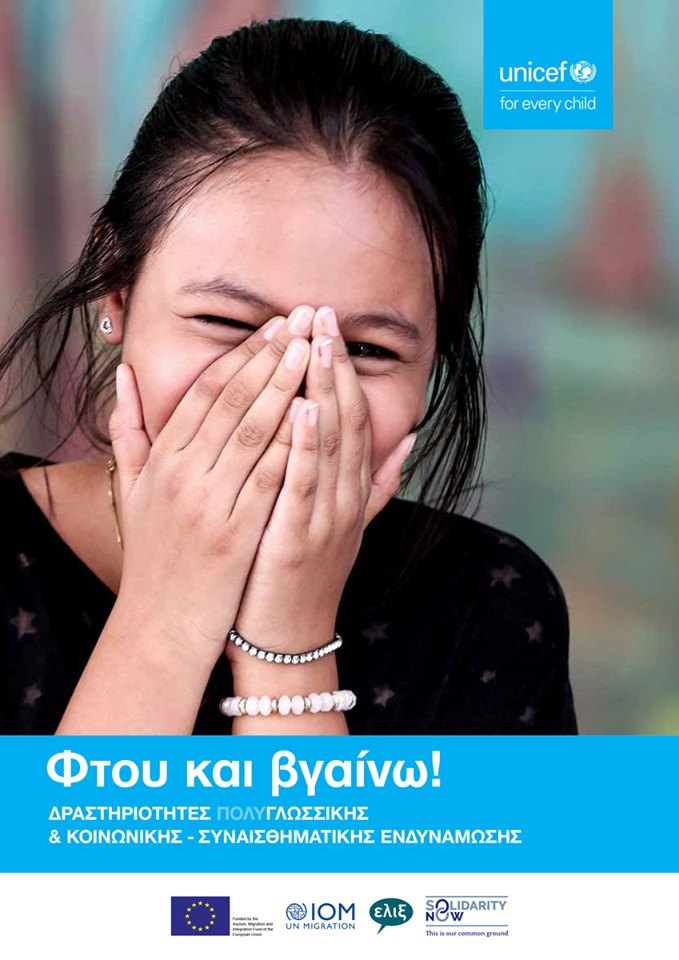
“Here I Go!” Our new educational toolkit


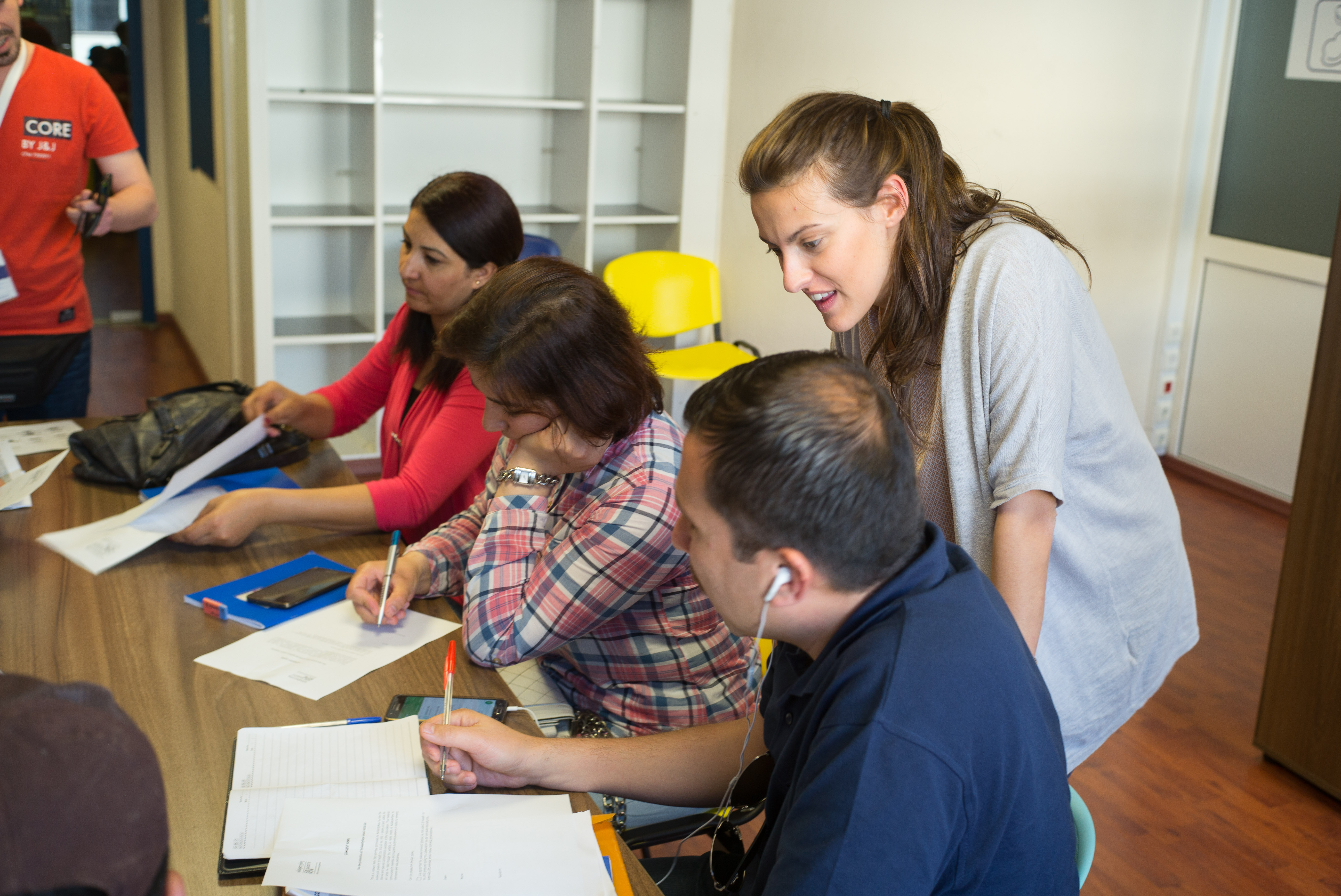
The toolkit “Here I Go!” is released! This is a handbook developed by Unicef, IOM, SolidarityNow and Elix as a bridge between a language teaching program and experiential learning activities designed to support teachers.

SolidarityNow teachers, Stephania Bouris and Danae Karagiannis, contributed to this very important publication that is supporting our children and facilitating the educational activities that we are implementing in 13 refugee centers in Greece.

More information, as well as the toolkit in digital format, here

* The “Here I Go!” toolkit was implemented with EU funding.
Social Worker

Submit until: -
Location: Lesvos

The post holder will be part of a wide multidisciplinary team, in charge of assessing and managing at the field the various needs of third country nationals and performing vigorous and solid field/street work. (S)he might be asked to support different programmes and undertake different roles and responsibilities depending on the needs of SN. (S)he will be available to work on evening shifts and/or weekends on a rotating basis. The ideal candidate possesses strong communication skills, is proactive and has an ability to troubleshoot, foresee, manage and mitigate tensions. (S)he is focused to the solution rather than the problem. (S)he has the ability to clearly and concisely report on the work performed. (S)he is organized, has stamina and the ability to perform under stressful conditions. (S)he has an easygoing, friendly personality and does not hesitate to establish and maintain contact. (S)he is resourceful and a smooth operator. The position requires a high level of personal integrity, basic diplomacy and courtesy manners and a high level of cultural awareness & sensitivity.


Remarks: Before submitting your CV, please read carefully the employees’ privacy notice on the processing of personal data pursuant to Regulation (EU) 2016/679 and the respective Greek legislation.

For roles that will have regular contact with vulnerable populations SolidarityNow is obliged to seek information about criminal convictions and offences, and selected candidates will be requested to provide a recent copy of criminal record.

Following the preventive measures against COVID-19, holding a vaccination certificate or undergoing Covid-19 antigen tests as per government directions is mandatory.

Huffington Post: The first UN World Humanitarian Summit: Results, omissions, and future goals


The first UN World Humanitarian Summit: Results, omissions, and future goals
By Arianna Tsolakoglou, Advocacy Officer of SolidarityNow

Published on the Huffington Post on 30.05.3016

The recently concluded, first-ever UN-led World Humanitarian Summit in Istanbul may be remembered as an impressive logistical achievement: around 9,000 stakeholders representing 173 countries, including heads of states, representatives of UN agencies, NGOs, civil society organizations, philanthropy, the private sector and academia came together to talk about how to improve aid delivery to people affected by various crises around the world.

Unlike the COP, for example, the WHS was not an inter-governmental process in which governments tried to agree on a specific text in advance. Instead, it sought a range of ideas from all actors involved in humanitarian aid. This automatically meant that is was bound to be somewhat unwieldy and unfocused. And to a great extent, it was. Yet, it also meant that many voices that do not traditionally have power were given a voice – and were heard. Either way, the very fact that the Summit took place in the chaotic and directionless way that it did, was in itself a tacit recognition of a narrative that has become increasingly popular: the humanitarian sector is an “eco-system” rather than a top-down, command-and-control system and for this reason, it requires a stronger shift to collaboration and cooperation, among all its actors. By bringing this wide range of actors to the table, the summit also helped put humanitarian issues higher on the agenda in the politics, business and society at large.

What was agreed on:
The most concrete outcome of the Summit was the top 30 donors and aid agencies signing a so-called “Grand Bargain” to make aid more efficient, including harmonizing time-consuming donor proposals and reporting, reducing costs, introducing collective needs assessments, and earmarking less funding to specific projects. Also a shift towards greater use of cash transfers as aid was generally endorsed but did not constitute a collective agreement.

The “localization” of aid was also an important agreement of the discussions, as the Grand Bargain affirmed it will direct 25 percent of humanitarian funding in a more direct and efficient manner to local and national agencies. The Summit also marked the launch of NEAR, a network aiming to “reshape the top-down humanitarian and development system to one that is locally driven and owned, and is built around equitable, dignified and accountable partnerships”. Twenty-seven international NGOs also signed the new Charter4Change, committing to passing 20 percent of their funding to national NGOs by 2018.

Among others, the Summit also agreed on and emphasized the need for more innovative approaches to financing. Several initiatives were announced, including a one in which private investors make an initial investment into a humanitarian response program and are reimbursed (with a profit) by traditional donors only if certain outputs are met, an autonomous, global Islamic endowment fund for humanitarian needs and a private-sector led initiative to increase risk financing in the most vulnerable countries.

Finally, it was agreed that the humanitarian sector needs to better respond to conflicts and shift the part of the focus off natural disasters, and that protracted conflict must be at the core of humanitarian work.

What was not agreed on (and should have)
Perhaps the biggest disappointment of a Summit whose primary aim was finding ways to prevent and end conflicts was the absence of world leaders, particularly the five permanent members of the UN Security Council. Apart from this –inexcusable- absence, what was striking was that a better deal for the people on the move and their hosts, was not made. Before the Summit, the UN Secretary General had proposed a fairer approach to sharing the burden of the people on the move with host countries, and a target to reduce internal displacement by 50 percent by 2030. To our disappointment, Summit participants only managed to agree on the need to pursue a new approach to address the needs of these vulnerable populations, without concluding anything more concrete, however.

Another great loser were the new actors who are at the very epicenter of the global humanitarian crisis – namely, volunteers and ad hoc civil society organizations who have come to the forefront in the last year or so, due the influx of the people on the move in Europe. The question of how to work with such groups, often made up of those with no humanitarian background or training, seems to have passed the WHS by. States have passed a resolution to better protect volunteers, but others on how volunteers can share information with professional humanitarians, were bypassed, sadly indicating that humanitarian actors that have stuck around for a while, are the ones who get the focus of attention.

The unwieldy list of individual and collective commitments of the Summit will supposedly be gathered into what the UN calls a “Commitments to Action platform”. But exactly how that will happen is not yet clear. The UN plans to “review” the commitments with the summit’s participants over the summer before the Secretary General presents a report to the UN General Assembly in September with recommendations for member states. But this does not mean that it is not vital for roadmap for delivering on the commitments made by all actors that attended the Summit, to be created. In fact, many of the participating actors have admitted to not knowing exactly how they will implement some of the commitments they made. And what is more serious than this?

What is certain about the first-ever World Humanitarian Summit is that it did not end. It is an ongoing process, which does not only involve proposing more structural changes to the humanitarian system, but also taking concrete actions to tackle the root causes of crises at a political level, and the political decisions that allow conflicts to flourish.

The fact that a global meeting that was premised on a reaffirmed commitment to humanity took place at all is already a major achievement. And besides, it would have been unrealistic to expect the Summit to be a revolutionary game-changer. But, it was a landmark in the sense that it effectively gave formal recognition to protracted conflict as the “new normal”, thereby acknowledging the scale and complexity of needs in this “new normal”, and the diversity of response required to address them.

Looking forward, the real challenge that lies ahead is to maintain the momentum of the Summit, and how to turn all the promises and commitments undertaken into meaningful – and measurable – humanitarian actions on the ground.

VIMA: The wounds and dreams of the refugees in the accommodation structure in Rovies


Their anxieties, their hope for relocation, and their gratitude to the Greeks

Published on the newspaper “To Vima”, June 3rd 2016

On one of the hottest afternoons of June, in the yard of a family hotel in Rovies, children are seen running, playing on the swings, playing quietly, almost silently, under thee shade of trees. Walid, one of the few adults who got up this morning, uses tools to take care of the garden, repairs what is broken, and is constantly looking for something to work on. In the kitchen, only few women help the cook to prepare traditional dishes of their homeland. Nearing the end of Ramadan, life for the people hosted at the hotel starts just before the sun sets, while breakfast is served at 2.30 in the morning so that they can endure the endless hours of fasting.For the past month, the coastal village of North Evia hosts 82 refugees who are eligible for relocation, and are mainly from Syria, with 40 children being among them. This is all being done as part of the Hosting and Housing Program implemented by SolidarityNow in cooperation with the United Nations High Commissioner for Refugees and with EU funding.

The full article is in Greek and can be found here