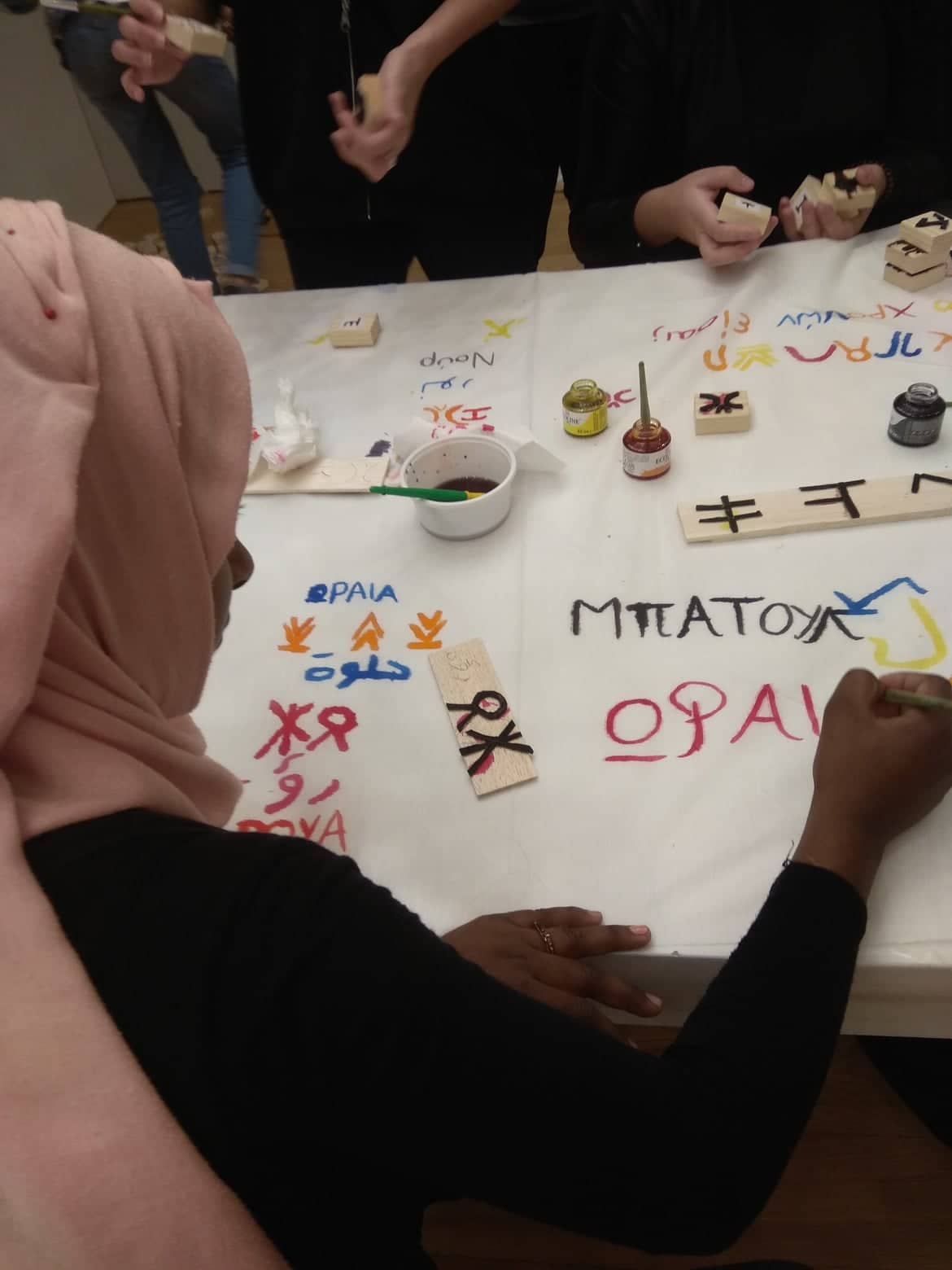
#SocialJustice_Eleni_She Claimed and Succeeded to Correct her Gender in Her Identity Card


Eleni K. 40-year old is a professional makeup artist. She decided to seek legal support at SolidarityNow’s Thessaloniki Solidarity Center, as she did not have the money to pay a lawyer to represent her in the change of her gender in the government-issued identity document.

From the age of 4 she felt that she was different. It’s not easy to be different in a world that wants you to be someone else. She faced many difficulties at school; her classmates were cursing and abusing her verbally. At the age of 18 she left her small town and went to Thessaloniki. She sought for “help” at the red light district. Then the only way to get a legal gender correction of your identity document was through prostitution, as the surgery was expensive. She was scared and feeling ashamed. She didn’t want to force herself to follow this path, as most of the people were doing back then. Her next step was to move to Athens, where she found a job as a makeup artist and cosmetics saleswoman. “There I felt more free,” she tells us. Family reasons forced her, five years ago, to return back to Thessaloniki. She continued to work for the same company, but for no apparent reason, after some time, she was fired. She thinks this was because she was wearing makeup, but they never admitted it.

At the age of 37, she decided to start hormone therapy. Legislation had now changed and the procedure to correct her/his gender on the identity card was easier than in the past. She talked to her family about her decision; her mother was very supportive, but her sister had some difficulties to understand her. “Suddenly there was a strong man next to her, a man who was a role model for her, and now she has ‘lost’ him,” says Eleni and adds, “fortunately now our relationship is good”.

Correcting her gender on her identity card was something very important to her, since she could no longer live as two different people. She wanted this situation to end as they questioned her identity everywhere, in public services and banks. When the court’s ruling came out, she had to go to her home town at the population registration office and the court of first instance to complete the process and take her identity. The whole process was frightening her but she met employees who helped her and did not make her feel bad. “I’m glad, because I can now do my job without any fear,” she says. “Life is too short; everything goes away and we must stop spending so much time sweating the small stuff,” concludes.

“The establishment of the right of the person to change his/her gender in the government-issued identity document is an important achievement for the LGBTQI + community. The imprinting of the gender on an administrative documents is an important step in defending the rights of transgender people,”  said the Legal Service of the Thessaloniki Solidarity Center.


*Thessaloniki Solidarity Center was established and is supported by Open Society Foundations.
World Day of Social Justice | #SocialJustice


#IHaveTheRight

SolidarityNow: Ensuring Social Justice

The World Day of Social Justice is celebrated every year on February 20th. Social justice is a continuous political and social claim. Many struggles have taken and taking place for social justice, as it gives rise to ideological and political oppositions.

But what is Social Justice? We can summarize its idea in some values ​​critical to an inclusive democracy: the general acceptance of the principle of Freedom for all, Equal and Fair treatment for all people without discrimination, Acceptance of the different and of inequalities, only as long as access to rights is open to all and only if it is intended to improve the lives of the most vulnerable and the less favored; social justice is the promotion of the basic social rights of people who are experiencing exclusion.

The erosion of the welfare state halts the access of all citizens to basic and inalienable rights such as Justice, Health, Housing, Employment, Education. SolidarityNow -through its Legal Services operating at the organization’s Solidarity Centers in Athens and Thessaloniki, but also with its Advocacy Department working to push for policy changes-, seeks to facilitate vulnerable social groups to claim their social and individual rights. And, at the same time, to criticize and put pressure on decision makers in order to limit the phenomena of favoritism.

On the occasion of the World Day for Social Justice we share the stories of Eleni, Mariam, Mohammed, Olga and Stefka, people who SolidarityNow supported, empowered and helped to reclaim their rights. To a degree, their struggle is an act of reclaiming Social Justice.


A couple without employment


Mary, the grandmother has already put food on the fire, the three children are getting ready for school and Anna and Andreas are talking, planning the day for the family. They will all meet again at 4 in the afternoon and will eat together the food that the grandmother has prepared.

We see Andreas and Anna getting ready to drop off the kids at school, Anna will kiss her husband when he drops her off at her work, he will follow to go to his. Both works currently, with a part time employment and are looking for a second job or a full-time job.

The couple remained unemployed for a number of years making it almost impossible to cover their needs. They both unexpectedly lost their jobs as a result of the financial crisis and since then they have both struggled to find permanent employment.

But You Can’t See Them.

Because at SolidarityNow we supported Anna and Andreas get reintegrated in society, through educational programs and networking with employers.

To date, we have done this with more than 300,000 people in need.

And we go on. 


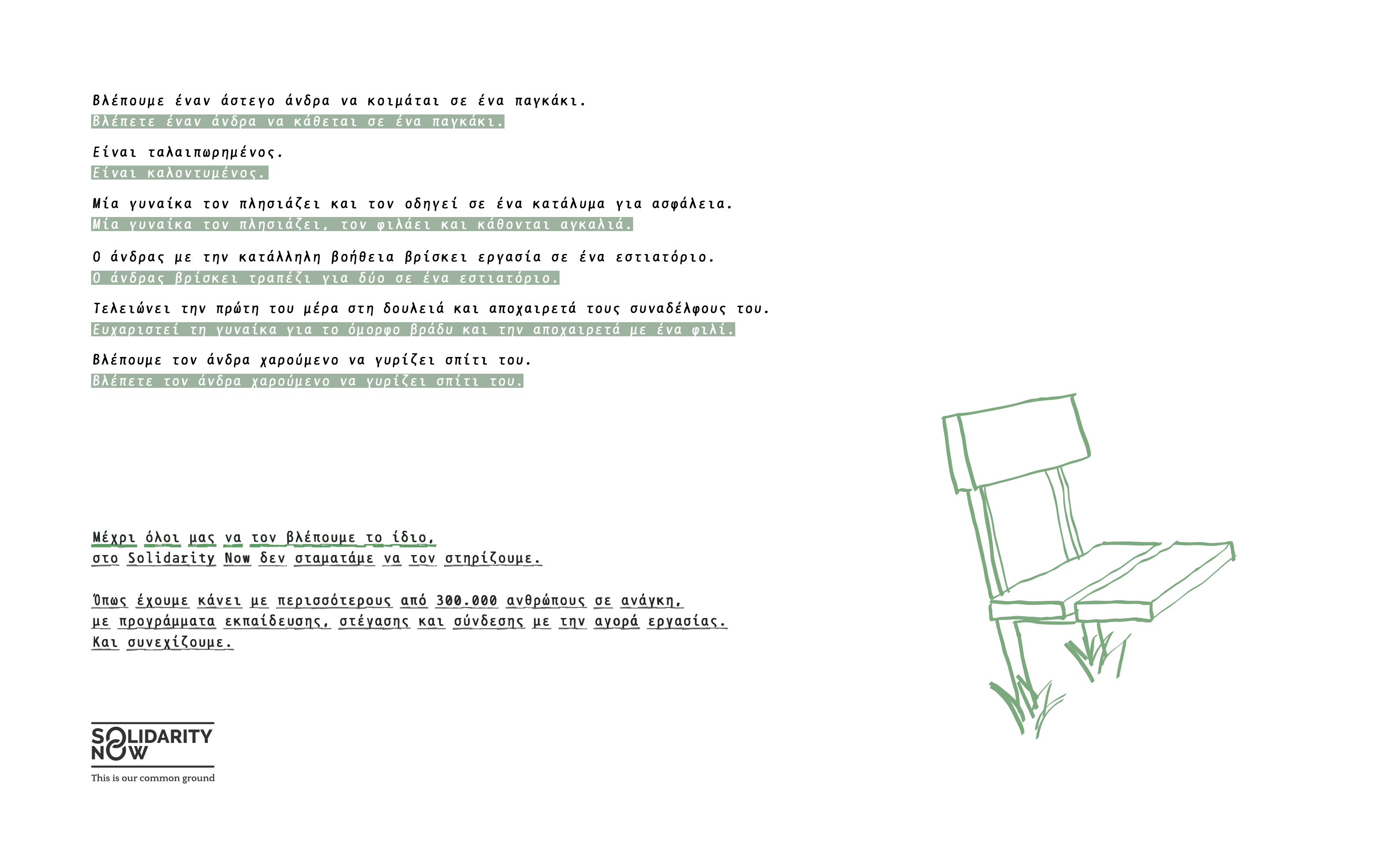
Homeless


He wears earphones and listens to music, at the same time, he hears the sounds of nearby traffic on the street. From time to time he greets shopkeepers in the area where he works, his job is very important, as he tends to the cleaning of the streets for all of us. And he likes his job, he feels proud to take care of his city.

He is 62-year-old Kostas, who lives in Athens, and we now see him working, being autonomous and independent and with a smile. When he gets off work, Mr. Kostas, will go rest at home. A roof he recently acquired as he was forced to live on the street for some time. The circumstances of his life lead him there and it took a great deal of effort not to give up on life and start over.

But You Can’t See Him.

Because at SolidarityNow we supported Kostas get reintegrated in society, through the employability and accommodation programs.

To date, we have done this with more than 300,000 people in need.

And we go on. 

Refugee Family


Four young girls are going to school and all of them are good students.

A 42-year-old man and his wife, their parents, walk on a main street of Athens and they themselves are going to school.

The next day they are all present at a celebration dedicated to the children. Their eldest daughter recites a poem at the celebration making everyone emotional. The poem is called “Peace” by G. Ritsos.

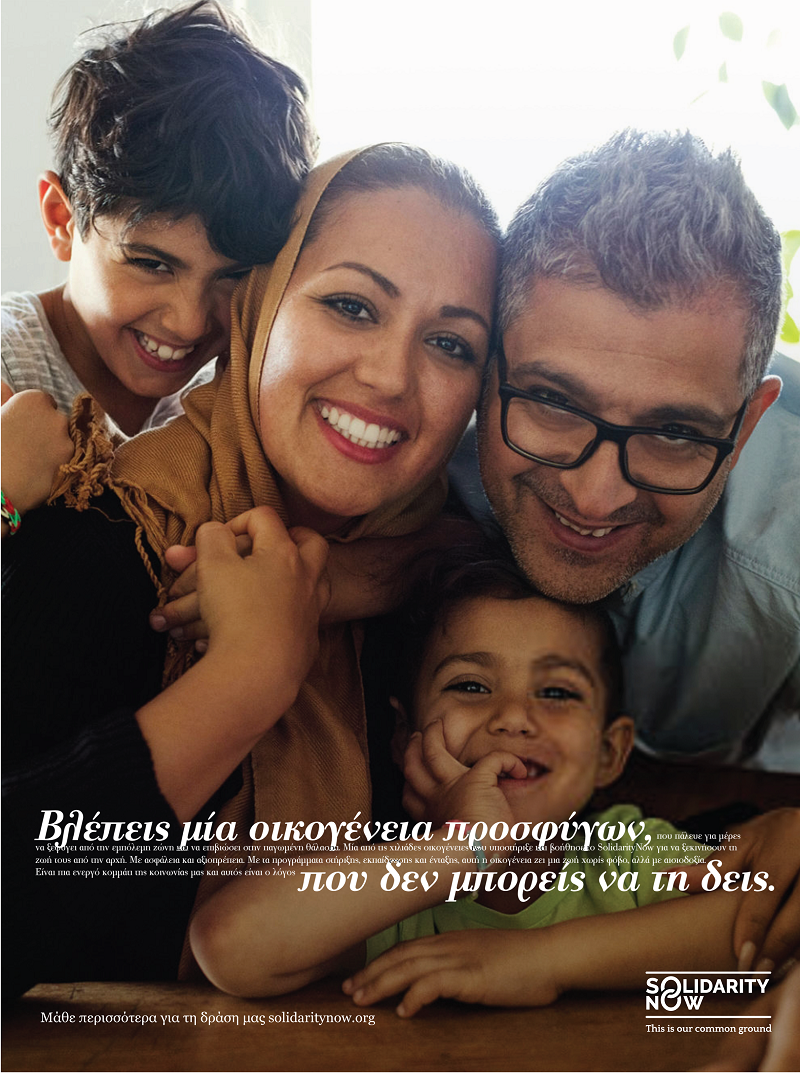
We see the family of Firas, one of the many families that came to Greece looking for safety and dignity something they were deprived of in their homeland. 42-year-old Firas, his wife and four daughters came to Greece from Iraq. Their first stop was at Farmakonisi. Firas was persecuted by the regime at his homeland, he lost his job, his life along with his family were all threatened. He had no other choice but look for safety elsewhere. That is how they decided to pursue their journey towards Greece by crossing the Aegean Sea.

But You Can’t See Them.

Because at SolidarityNow we supported this family to integrate in society, with accommodation and educational programs.

To date, we have done this with more than 300,000 people in need.

And we go on.

Battered Woman


Maria drops off her son at school and runs off to make the bus that takes her to her job. On her way there, she observes other women and she smiles. How amazing is the hair of some of these women! Some of them might become her clients, and they will in turn be happy, as are the women who have already trusted Maria for the care of their hair.

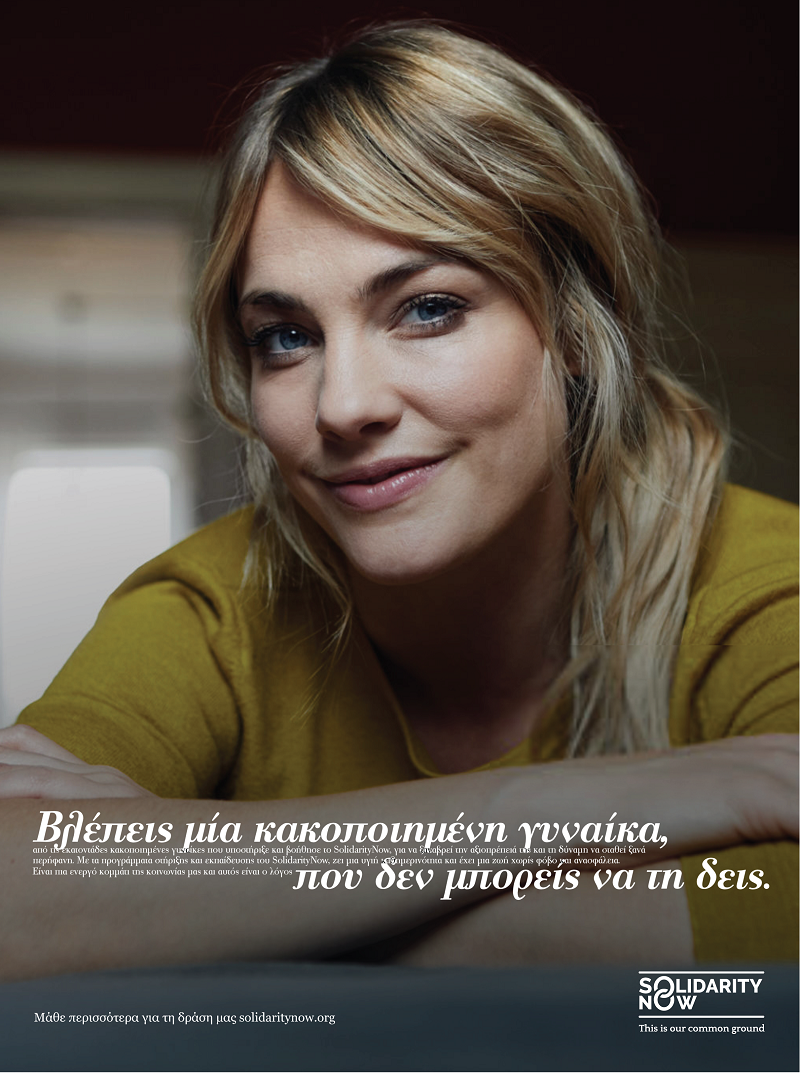
We see 34-year-old Maria from Athens, a working divorce. Her beloved son was the main motive in her decision to change her life and remove herself from an abusive environment. Maria shared many years of her life with her partner, who failed to provide her a sense of safety. The opposite took place. The erratic behavior of her partner and father of her child, was another repetition of abusive behavior that brought her into isolation.

But You Can’t See Her.

Because at SolidarityNow we supported Maria to re-integrate in society through educational and employability programs.

To date, we have done this with more than 300,000 people in need.

And we go on.


#WomenInScience: Anna-Maria


“I shall also be one of the women that will not quit her dreams…”

“At the Polytechnic University I became aware of how ‘male dominated’ the sector is and during my studies on education/teaching I experienced the ‘female domination’. It is unbelievable that even today these sex differences exist in the choice of studies and thus, professions”.

This is the opinion of Anna-Maria, one more woman who loves technology and science and shares her story with us in the context of the tribute #WomenInScience, concerning her experience as a student in this field.

Raised by a father who is a forestry expert and a mother who was a traditional homemaker, Anna-Maria grew up in a large suburban town, showcasing her inclination towards technology and computer science (IT) from an early age. After excelling in her final exam on IT, her teachers encouraged her to study something closely related to IT. She ended up completing her university diploma at the Department of Primary Education at the University of Ioannina, she then pursued a graduate degree at the University of Piraeus in the Department where she received a master’s degree in digital systems, with a focus on e-learning.

And she continues to amaze. This year she decided to enroll at the Vocational Highschool, and she reboots her relationship with IT, and her innate need to expand and further her knowledge. “I always loved technology and IT. I believe it is the future in the field of education. In education, gender or other barriers should not exist”. Her love for technology in conjuncture with her need to further her knowledge paved her way for her to reach SolidarityNow; where she followed and graduated from the educational program IT Essentials, which was implemented by SolidarityNow in partnership with Cisco.

Anna-Maria remembers that at all levels of education she confronted social stereotypes that directly or indirectly affected the direction of her studies, profession, and the life path she would follow, one that is “ideal for a woman”. As she recalls “when I was completing my thesis, even the subject choices were limited if you were a woman. I was treated by others like I could never been successful in the field of technology, without being ever given the opportunity to prove oneself. Male professors especially looked at us quite disparagingly.

I believe the time has come for the deeply rooted stereotypes to change. I believe there have been a lot of improvements compared to previous years, even though I am still caught by surprise when I hear parents advising younger girls to become teachers, as this is among the professions best suitable for women. Men are still more free to decide what their profession will be leading to disciplines where the racial inequality remains huge”.

Anna-Maria remembers her IT teacher sharing with her students her worries about their professional future, explaining her own difficulties in establishing herself as an equal “partner” in a field that rejected her for a long period of time due to her gender.

“Things are tough out there, especially when you are a woman and your wish is to do something “different,” but I truly believe that we can finally change this. I shall also be one of the women that will not quit her dreams due to the anachronistic perceptions”.

#WomenInScience: Feriste


“My husband is the first person in my life, who pushes me to continue my studies”

Feriste, 25, from Afghanistan, along with her husband and daughter, have been living in Greece for the last 2.5 years. Their daughter was born here. If the Greek law was different, she would have taken the Greek citizenship. We all met one afternoon at SolidarityNow’s Thessaloniki Solidarity Center. Her daughter was on her father’s arms, playing with coloring pencils, giving us shy smiles and trying to communicate with us in every way. Feriste, proud of her family, spoke to us about her life in Afghanistan, her studies, and Greece, her potential new country.

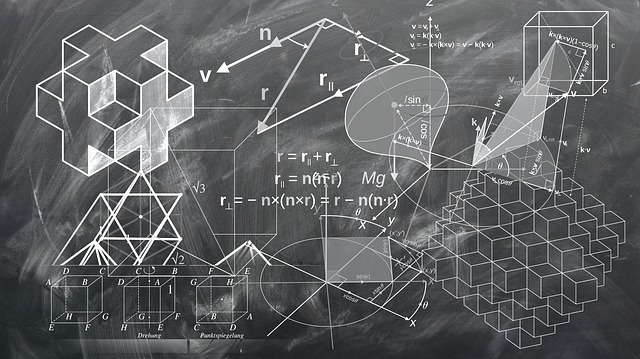
Life is full of equations, operations and imagination as well as mathematics. “At first, mathematics has to do with numbers, but when you get deeper, you have to use your imagination. You must have in your mind a 3-D photo to understand them. But to be able to see it, you need to be able to use your imagination”, says Feriste, who has studied mathematics. She is an only daughter -she has 3 brothers- and is the only one in her family who went to University. Although her mother, has only been in school for 3 years and her father for 8 years, they both encouraged her to follow her dreams.

“At first it was difficult to understand mathematics because of my country’s education system. Many times we didn’t have professors. As a result, the older students were the ones teaching”, she notes. The things have improved in the University, but there were other problems, bombs, attacks, a scenery of war. Very often, her parents were afraid of her life, but Feriste insisted and continued her studies; in 2016 she got her degree and then she got married. With her husband they met at the University, they were fellow students. “When I was a child, my dream was to become an educated and useful woman. My parents always supported me, and I learned many things from them. That’s why I wanted to study and help my family for all these difficulties they have gone through”, she emphasizes.

“After graduation, my father first came and told me that this is not the time to search for a job. I was very disappointed. I was studying so many years to stay home, but I couldn’t do anything about it”, she points out. Sometimes mathematics can lead you to dead ends, and that’s where the imagination comes in. Together with her husband they left Afghanistan and travelled to Iran. There, her husband worked as a farmer in the fields. “Early enough we realized that there was no future for us in Iran. For Afghans, Iran is not an easy country”, she adds. They came to Greece in October 2017. Her only worry was to be in a country where they would feel free and they would have a prospect of creating a better future. “Now that we are here, it is not always easy to pursue our dream”, she says.

Feriste and her family live in an independent apartment ran by an organization, in Thessaloniki. Their relationship with SolidarityNow began a year ago when they came to the Blue Refugee Center to attend Greek lessons. “There we could leave our daughter in the women’s space and at the same time attend the lessons. We also talked to the employability advisor, but it is very difficult to find a job in Greece; everyone wants you to speak Greek. The team at the Center was very polite and helpful, but we needed to take intensive language lessons”, she explains.

Today, Feriste attends Greek courses at the Aristotle University of Thessaloniki, while her husband is taking after of their daughter. “My husband is the first person in my life who pushes me to continue my studies”, she undernotes. We ask Feriste what she wishes for her future. Her dreams focus on education: “We want to be in a place where we can continue our studies. Because things in Afghanistan were not easy for us. I wish for our daughter, for our children to have an easier life”.

* The Blue Refugee Center is supported by UNHCR GREECE and funded by EU.

** Thessaloniki Solidarity Center was established and is supported by Open Society Foundations.
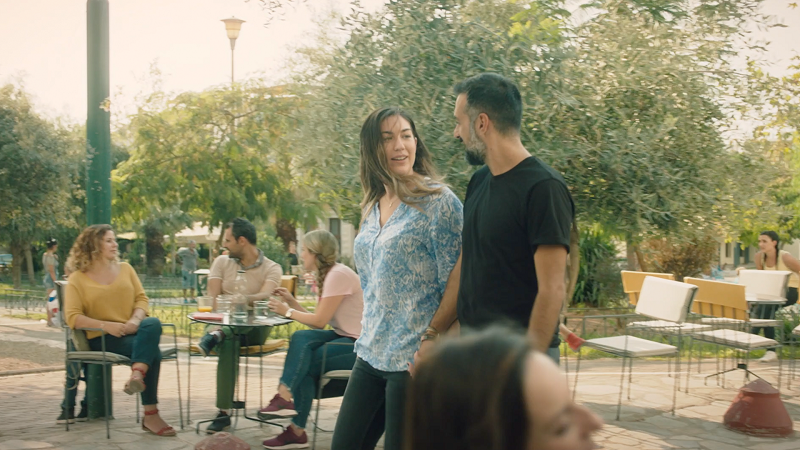
#WomenInScience: Rosa


“Mathematics for me is a philosophy. A philosophy interconnected with all other sciences”

Knowing Rosa, even a little, we didn’t have to think a lot about how she got her name. Close to the example of Rosa Luxemburg, the brilliant 26-year-old Rosa from Athens is revolutionary and politically motivated; two characteristics that have affected her personal development in a male-dominated sector: Science, Technology, Engineering & Mathematics (STEM). Rosa’s name was chosen by her parents.

In her mathematician father’s library, Rosa saw so many books on mathematics! She singled out the one about women mathematicians who existed, to her surprise, since she believed up to an age that men and mathematicians are synonyms. Rosa has since understood that there are no limitations in science and of course sex could not be such. She didn’t immediately admit that math would be her field of study in the future. Her reaction was mainly caused because she refused to answer the question asked to teenagers – “What are you going to study? What will you be when you grow up?“. Overcoming this “social pressure”, as Rosa names it, and the opposition to follow her father’s model, she finally chose science as her field of studies. She loved her courses on biology, chemistry, physics and, of course, mathematics! However, Rosa never forgot her other love, history, which she found the way to connect it with mathematics. What she liked was the history of mathematics and its cross-disciplinary approach: “Schools are restrictive in the cross-disciplinary approach of the sciences. For example, integrals. I was wondering when reading for my exams how did we get to the integrals socially? What social conditions led there?“.

However, she didn’t get ahead in mathematics schools – instead she got her bachelor by the University of the Aegean, School of the Environment, Oceanography. This school sounds very different than the mathematics Rosa wanted to study. “It is not“, she replies, “it is a school full of science courses, applied mathematics, and so I fulfilled my need for interdisciplinarity through the combined sciences’ approach“. Throughout her studies she reads about oceanography, its establishment as a science, the role of women in it, discovering its importance during the Second World War, when the heroes who helped the “male affair, called war” were in fact heroines – those “invisible” women who had the knowledge and helped submarines and soldiers.

Rosa graduated by submitting her BA thesis on “The establishment of Oceanography as a Science and Sex” and had already decided to continue with postgraduate studies. She chooses an exceptional subject for her research inspired by other schools’ courses, such as sociology and gender anthropology. At the same time, she is experiencing a close encounter with the refugee crisis in Lesvos and is voluntarily participating in the work of organizations helping refugees on the island.

Rosa, a 22-year-old girl, is shocked by the refugees’ situation, “I’m living very close to death, I am shocked by its impersonal character, deceased persons are like anonymous, travel’s discontinuation either by natural causes or by other types of boundaries moves me“. That’s what makes Rosa “mix them all together”, as she says. Sea, mathematics and genders are the three pillars of her postgraduate research entitled “Dying on a foreign land: An ethnographic approach to the death of displaced people in the city of Mytilene”. We ask her about her research theme: “I chose it because even death is a male affair. In my research, I had to interview people so as to investigate the procedure followed for the deceased people and all of whom I had to talk with were men, both institutionally and professionally”.

Today, Rosa lives and works in Athens. She is thinking to continue her studies abroad in order to explore the fields of robotics and artificial intelligence. Until then, she continuously strengthens her skills in the wider field of her interests and so we get to know her. Rosa has attended and graduated from the educational training program implemented by SolidarityNow in co-operation with Cisco, IT Essentials, and she notes that it has helped her a lot to understand how a computer works in its essence, the networks’ function, the capabilities it offers – it opened her mind to a new philosophy.

Rosa, a lover of lifelong learning, states that “I haven’t completed my studies. I will go further, and I will also become a living proof that women can do as well, if not better, in the field of science too”.  

#WomenInScience: Sana from Pakistan

SolidarityNow

“I am a mathematician, who life has made her an artist”

Sana comes from Pakistan and has been living in Greece for the last 7 months. She speaks fluent English. She has studied mathematics, just like her mother. Actually, she had begun a postgraduate course, but she was unable to complete her studies since she had to leave her country. Her dream is to continue her studies and do a Ph.D. Her mother raised her and her two brothers to love math. “Mathematics is my love”, she states. They say math needs imagination. “Mathematics is a real-life fantasy game. It is real. People believe the unknown x does not exist, but it’s always there, and you need to be open-minded to see it”, she explains.

Sana is a woman of many pursuits and an avid individual. She writes poetry, has a strong interest in literature and wants to publish her own poetry and novel book. She has already pictured herself interviewing journalists for her book. Her relationship with writing began when she was 16 years old. Her favorite poets are the Pakistani Mohammed Iqbal, also known as Allama Iqbal and Mirza Ghalib. “I have never imagined myself writing poetry. When I was finishing a text, I was wondering why I wrote it”, she explains. “You are also an artist”, we say to her, and she corrects us by telling us that “I am a mathematician who life has made her an artist”.

“My poems are about the situations I face. There are things in my mind that I cannot tell anyone. I observe people, their behavior and then I write. I write about the feelings I have”, she stresses. The theme of her writings has changed in time. Now what matters most to her is everything that has to do with her journey and memories from her homeland. “You never know what you’re going to write”, she underlines. Poetry has no program, it is something that “happens” spontaneously. Sana prefers to write late at night when everyone is asleep at home. “I just grab a pencil and paper and I write down my thoughts”, she says. We ask her if she reads her texts to her family and she tells us that her mother proudly posts them on her social media while her brother sets her texts to music. Both of them encourage and support her in every way.

In addition to poetry and fiction, Sana eagers to learn Greek and to continue her studies in Greece. Her dreams led her to SolidarityNow’s Blue Refugee Center in Thessaloniki. There she was informed about the manicure-pedicure seminars, which were organized in the context of the organization’s Education Program. As a more positivist mind, she had some hesitations at first on whether she would like the lessons. Basically, she thought that it would be dull, but her perspective changed when she started attending the seminars. Her goal now is to attain her own beauty salon. Can math be combined with manicure-pedicure? Sana replies yes. “When you work with math all day you feel tired. The manicure-pedicure relaxes me, and I feel like taking care of myself as a woman”, she points out.

How does life in Greece treat a young girl from Pakistan? Sana replies with a title of a Beatles song: “Here we are free as birds; we can go wherever we want”. The good weather, the friendliness and the smile of the people are some of the main reasons that make her want to stay in Greece. “You never feel alone in Greece; you constantly have people around you, especially in the Blue Refugee Center. Anyone who comes is welcomed with a smile. The staff here has a very strong relationship with people. I cannot find a word that accurately describes this relationship. I realized that the feeling I have developed here is something I lacked back in Pakistan. Everyone feels unique in their lives, and here I have also become unique”, she explains.

Sana is optimistic about her life and her future. She claims that her mother has raised her in a similar manner: “she gave me all her positive energy”. “Even when other people think everything is dark, I say no, there is always a light out there”, she says with confidence, convincing us as well. Listening to her talking about life, we recall the lyrics of a Smiths song, “there is a light that never goes out”.

Closing our vivid discussion, we ask her if she wants to send out a message. She smiles and putting her hands on the table stoically, tells us a well-known phrase that the first Pakistani Nobel laureate physicist, Abdul Salam had said “Never stop learning, because life never stops teaching”.

“We are obliged to constantly learn new things and evolve. At first, I thought the seminars would not be interesting; I thought they would be too simplistic. But then I thoroughly enjoyed them. I am very sorry for those who missed the opportunity to attend, but I feel very lucky to have completed the lessons and to hold my new diploma in my hands”.

* The Blue Refugee Center is supported by the United Nations High Commissioner for Refugees and UNICEF and funded by the EU.