Let us help them!


Greece joins a pan-European coalition that aims to reflourish solidarity and respect towards refugees

Athens, 23rd May 2018 – For the first time, a coalition of 130 civil society organisations have launched a European Citizen’s Initiative (ECI) for a shift in migration policy. The aim of the We are a Welcoming Europe campaign is to collect 1 million signatures in at least 7 Member States; compel Europe to consider our proposals; and adopt a more humane and realistic approach towards the major challenge of migration.

The campaign that is being launched today in Greece with the support of several civil society organisations, is based on two main principles: it seeks to put the European citizen at the heart of migration policy and to reinforce the rights of migrants and refugees. Through this initiative, European citizens are given the chance to have a more active role in shaping migration policy at the local and national level. The campaign has three specific requests:

  1. Support the citizens and volunteers that want to help refugees;
  2. Put an end to the “crime of solidarity” which is in practice by several EU Member States, including Greece;
  3.  Ensure respect for the fundamental rights of migrants and asylum seekers, by reinforcing the complaint mechanisms regarding labour exploitation and other abuses by European border guards.

Sign the petition now

At the turn of the 21st century, migration has become a major issue for our societies. It is becoming increasingly clear that an appropriate response can only come from a common European policy. However, Member States have not had a coordinated response on the issue of the reception of men, women and children who are fleeing all kinds of violence and look for safety in Europe.

On 15 December 2017, seven European citizens submitted to the European Commission the first European Citizen’s Initiative on migration. They represent the voices of all those who disagree with Europe’s migration policies and aim to initiate together a policy shift. Today, we, the citizens of Greece and Europe, are raising our voices so that we can welcome and advocate for those who are in need, regardless of their legal status or nationality and without fear of being prosecuted.

The first partner organisations in Greece:

Actionaid

Caritas Hellas

Greek Forum of Refugees

HIAS

Jesuit Refugee Service

Klimaka

SolidarityNow

Terre des hommes
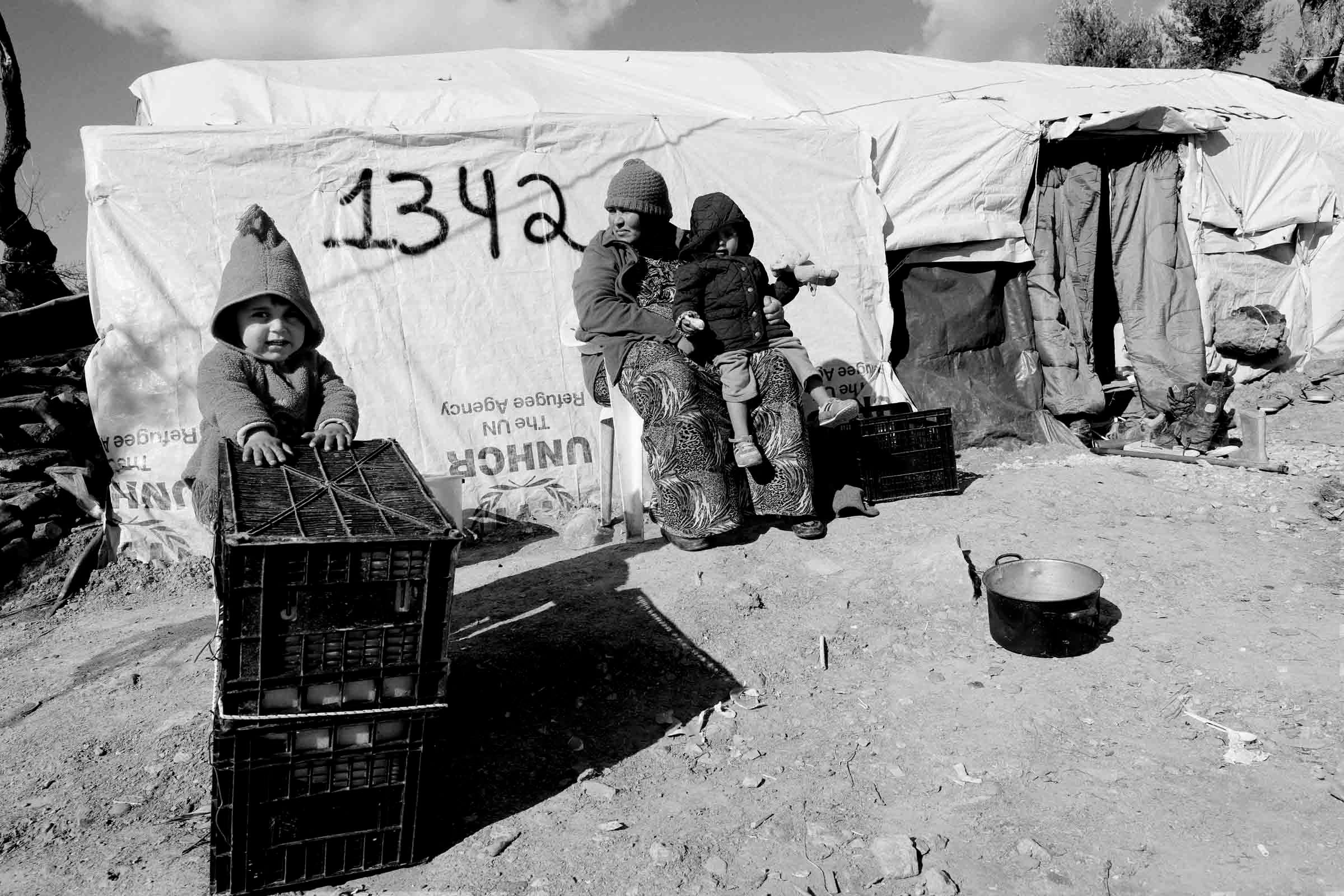
Greece: Government Defies Court on Asylum Seekers

Giorgos Moutafis for SolidarityNow

Reinstates Containment Policy That Keeps People Trapped on Islands

(Athens, April 25, 2018) – The Greek government’s move on April 20, 2018, overturning a binding court ruling ordering it to end its abusive policy of trapping asylum seekers on Greece’s islands raises rule of law concerns, 21 human rights and humanitarian organizations said today.

Rather than carrying out the April 17 ruling by the Council of State, the country’s highest administrative court, the government issued an administrative decision reinstating the policy, known as the “containment policy.” It also introduced a bill on April 19 to clear the way to restore the policy in Greek law. Parliament members should oppose such changes and press the government to respect the ruling.

Parliament began discussing the draft law on April 24. But the government has preempted the debate on the bill, including the issue of the containment policy by reinstating it. On April 20, the new director of the asylum service reissued an administrative order setting down the reasons for the containment policy. Among grounds given to justify the restrictions imposed by the policy are the need to implement an EU-Turkey deal on migration and a broader public interest claim. But the decision goes against the Council of State ruling and Greece’s responsibilities under international, EU and Greek law, as it offers insufficient justification for the restrictions, the groups said.

The Council of State’s April 17 ruling said that Greece’s containment policy had no legal basis and that there were no imperative reasons under EU and Greek law justifying the restrictions to the freedom of movement of asylum seekers. It ordered the annulment of the administrative decision imposing the restrictions and permitted the free movement of asylum seekers arriving on the islands following the ruling’s publication. The ruling also highlighted that the disproportionate distribution of asylum seekers has overburdened the islands. The ruling is limited, however, applying only to new arrivals.

The draft law is currently being discussed before the parliament’s Standing Committee for Public Administration, Public Order and Justice and will be debated by the full parliament in the coming weeks. The bill seeks to provide a legal basis for the containment policy. It would incorporate into domestic law EU Directive 2013/33, which sets standards for the reception of asylum seekers. While the draft bill would possibly bring some improvements to the Greek reception system, the directive allows restricting the movement of asylum seekers when the government considers it necessary for rapid processing and effective monitoring of claims. The Greek government presumably believes that the legislation would provide a stronger legal basis for maintaining the containment policy.

Greece’s abusive containment policy was put in place in March 2016, with the support of the European Union and its member states. By the latest government count, more than 15,400 asylum seekers are on the Greek islands. Many are living in crowded and filthy processing centers, and many spent the winter in lightweight tents or even sleeping outside on the ground. The Greek government contends that the containment policy is necessary to carry out its commitment under the March 2016 EU-Turkey migration deal, under which asylum seekers must be returned to Turkey to have their asylum claims processed there, although the text makes no reference to such a policy.

The case was brought before the Council of State by the Greek Council for Refugees, a non-governmental organization providing legal support to asylum seekers. Nongovernmental groups began a campaign to #OpenTheIslands in December 2017, calling on Greece and its EU partners to transfer asylum seekers to the mainland before winter and end the containment policy.

In seeking to justify the containment policy, the Greek government, EU institutions, and governments point to increasing numbers of migrants and asylum seekers crossing the Aegean Sea, some fleeing intensified conflict in Syria. Yet there is no evidence that lifting the containment policy would be a pull factor, as Greece and others claim, especially given the largely closed borders along the Western Balkan migration route into Western Europe.

It is evident that the Greek authorities cannot meet the basic needs and protect the rights of asylum seekers while they remain on the islands, the groups said. The containment policy traps people in conditions below EU minimum standards, impedes their access to necessary services, and denies them access to fair and efficient asylum procedures because of the overcrowding on the islands and the lack of basic services.

Rather than restoring its abusive containment policy, the Greek Government should respect the rule of law, immediately carry out the Council of State ruling by allowing asylum seekers to move to the mainland, and along with its EU partners ensure protection for all asylum seekers in Greece, the groups said.

The government should rapidly expand safe accommodation and access to services on the mainland and create a system to move people quickly to mainland accommodation that provides for their medical and mental health needs while their asylum application is processed. The EU should look at sharing responsibility across member states and increasing availability of more safe and legal channels into the EU.

Containing asylum seekers on the Greek islands in substandard and appalling conditions that violate their rights and Greece’s international obligations cannot be justified for migration control purposes, the groups said.


Organizations Signing the Statement:

Advocates Abroad

Amnesty International

AEDH (Association Européenne pour la Défense des Droits de l’Homme)

Caritas Hellas

European Council on Refugees and Exiles (ECRE)

EuroMed Rights

FIDH (International Federation for Human Rights)

Gisti (Groupe d’information et de soutien des immigrés)

Greek Council for Refugees

Greek Forum of Refugees

Greek Helsinki Monitor

Human Rights Watch

HumanRights360

Jesuit Refugee Service

Lesbos Legal Center

Oxfam

PRAKSIS

Refugees International

Refugee Rights Europe

SolidarityNow

Terre des Hommes

GEOGRAPHICAL RESTRICTION OF ASYLUM SEEKERS ON THE GREEK ISLANDS: WHAT IS THE IMPACT OF THE RECENT GREEK COUNCIL OF STATE’S DECISION?

Giorgos Moutafis for SolidarityNow

Athens, April 19, 2018

SolidarityNow welcomes Ruling No 805/2018 of the Greek Council of State (the country’s Supreme Administrative Court) (“the Ruling”), which annuls the Asylum Service’s Decision (No 10464/31.5.2016) imposing geographical restrictions on six islands of the Eastern Aegean Sea (Lesvos, Samos, Chios, Leros, Rhodes and Kos). The case was brought forward by the Greek Council for Refugees.

The Ruling lifted the geographical restrictions on asylum seekers arriving to the islands from now onwards, given that the contested Asylum Service Decision did not set out the legal grounds for imposing such restrictions on asylum seekers’ freedom of movement and their confinement in Reception and Identification Centers (hotspots) on the islands (the so-called “containment policy”). In addition, the Ruling highlighted that the regime of geographical restriction within the aforementioned islands has resulted in unequal distribution of asylum seekers across the national territory, over-burdening and exercising significant pressure on specific regions.

Insofar there are no imperative reasons of public interest and migration policy that would justify restricting applicants of international protection to the Greek islands, the Court decided to annul the administrative decision imposing such restrictions and ordered the free movement of asylum seekers arriving to the islands following the Ruling’s publication. The Ruling, however, does not have retroactive effect, i.e., the geographical restriction will continue to apply to over 13.000 asylum seekers currently residing on the islands.

SolidarityNow greets the Ruling as a victory for human rights and asylum law in Greece, in line with our organization’s continuous pressure against the containment policy – through joined letters to the authorities (see here and here) and the #OpenTheIslands campaign, supported by many organizations during 2017.

However, we express our concerns regarding the implementation of the Ruling by the Greek Government and competent authorities:

  • Firstly, the Ruling has no retroactive effect, which results in unequal treatment between asylum seekers already restricted on the islands, on one hand, and those who come after the Ruling and can freely move. Such discrimination could be explained by the difficulty around the immediate decongestion of the islands and the need to organize proper accommodation in the mainland. This could be resolved only by a Government decision providing for a timely and gradual decongestion of the islands, as part of a well-organized, nation-wide plan.
  • Secondly, the Ministry of Migration Policy (“MoMP”) seems to be planning the imposition of geographical restrictions anew, on the basis of a law transposing EU Directive 2013/33. The draft law is already submitted to the Greek Parliament for voting (see the MoMP’s announcement in response to the Ruling).

Thus, we are keen to see how the Ruling will be implemented, anticipating the free movement of newly admitted asylum seekers on the Greek islands until the draft law is adopted, and geographical restrictions are potentially re-imposed by an executive decision of the Greek administration.

SolidarityNow strongly opposes the creation of a “multi-speed” asylum system, which randomly favors certain asylum seekers while violating the rights of others and transforming the Greek islands to “buffer zones”. We insist on the need to lift geographic restrictions altogether, along with the adoption of a strategic, long-term plan – at both national and European level – for an equal and fair distribution of refugees and asylum seekers throughout the Greek and EU territories, in accordance with the principles of refugee law and with respect for human rights.

Racist Violence Recording Network – Annual report 2017


In its annual report for 2017 the Racist Violence Recording Network (RVRN) analyses the quantitative and qualitative results of the over 100 incidents of racist violence and hate crime reported last year by its 42 members, including SolidarityNow.

The RVRN report documents the coexistence of opposing trends in Greek society. On the one hand, the presence of groups with xenophobic ideologies and acts of organized violence against organizations of refugees, immigrants, LGBTQI and their defenders was strengthened. On the other hand, the authorities have developed clearer and faster responses.  The Network calls on the government to intensify its efforts to protect people against racist, homophobic and transphobic violence.

Read the full report 

RATIFICATION OF THE INSTANBUL CONVENTION


The Greek Parliament has finally ratified the Council of Europe Convention on preventing and combating violence against women and domestic violence (Istanbul Convention), and revised the relevant Greek law provisions.

The Istanbul Convention is the first complete framework for combating gender violence, and a very important step towards the Council of Europe’s efforts to ensure respect of women’s rights. Domestic violence and violence against women, in all its forms (verbal, physical, and psychological), constitutes the utmost expression of dominance between genders, and has come to the fore in Europe as a central issue of human rights’ violation.

Among others, the Istanbul Convention devotes an entire chapter to women migrants and asylum-seekers facing gender-based violence. It is the first time that gender-related persecution is mentioned in an international convention, establishing the obligations to recognize gender-based violence against women as a form of persecution within the meaning of the 1951 Refugee Convention, as well as to ensure that a gender-sensitive interpretation be given when establishing refugee status.

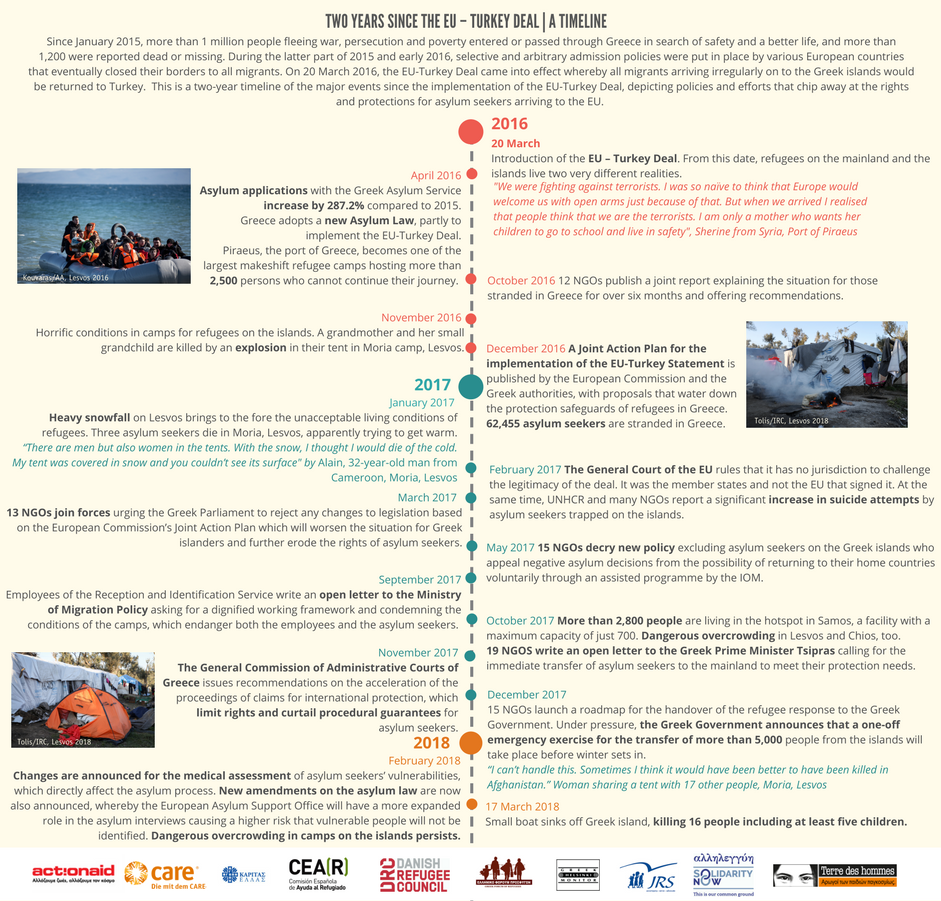
Τimeline of the major events since the implementation of the EU-Turkey Deal


Since January 2015, more than 1 million people fleeing war, persecution and poverty entered or passed through Greece in search of safety and a better life, and more than 1,200 were reported dead or missing. During the latter part of 2015 and early 2016, selective and arbitrary admission policies were put in place by various European countries that eventually closed their borders to all migrants. On 20 March 2016, the EU-Turkey Deal came into effect whereby all migrants arriving irregularly on to the Greek islands would be returned to Turkey. This is a two-year timeline of the major events since the implementation of the EU-Turkey Deal, depicting policies and efforts that chip away at the rights and protections for asylum seekers arriving to the EU.

Timeline on EU Turkey deal


Joint Press Conference: Two years after the EU-Turkey Deal


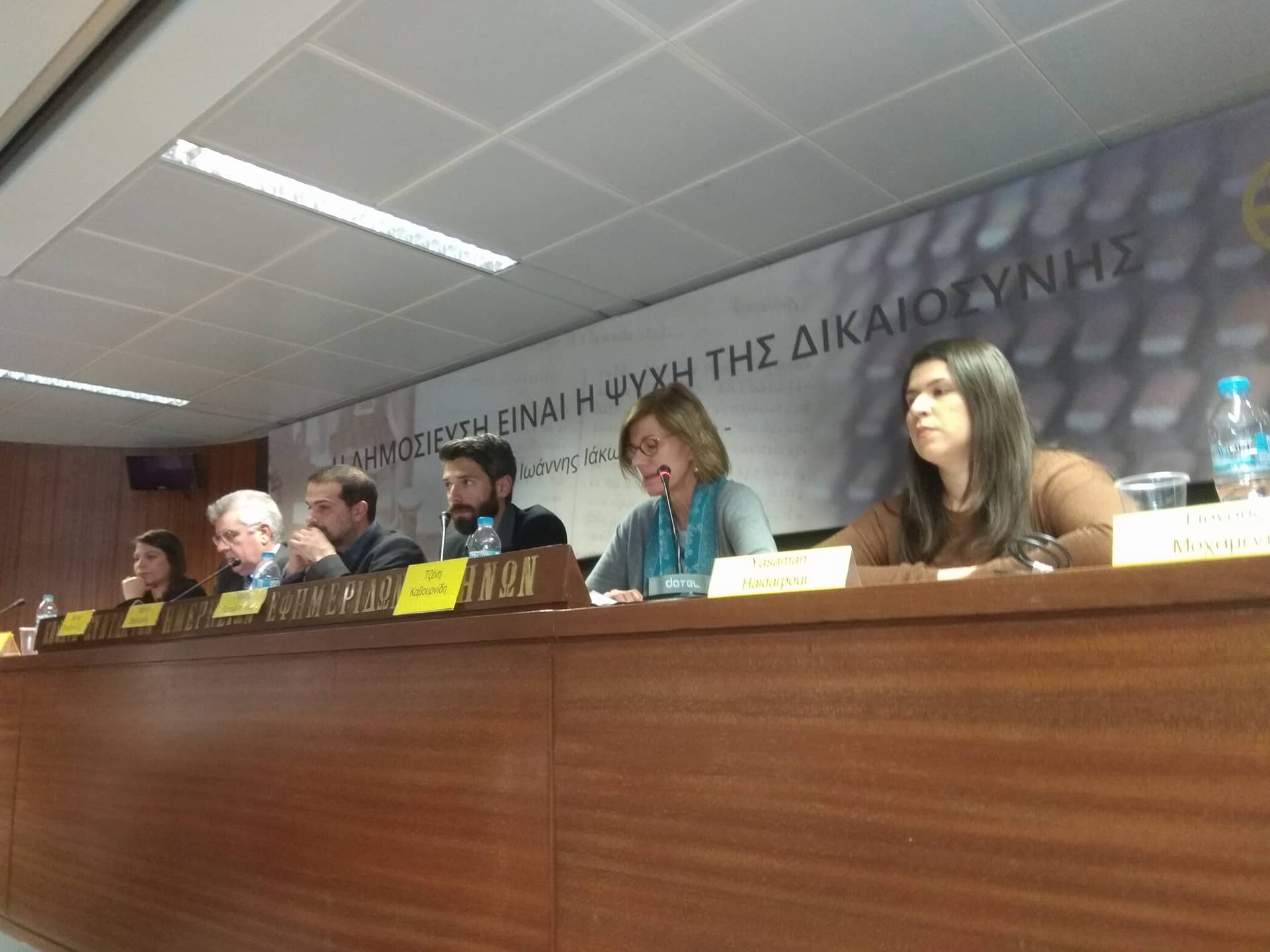
To mark the occasion of the second anniversary of the EU-Turkey Joint Statement (Deal, in essence), yesterday we held, along with other NGOs, a joint press conference titled: “Two years after the EU-Turkey Deal: a humanitarian tragedy for refugees and asylum seekers”.

The press conference was hosted at the Journalists’ Union of Athens Daily Newspapers (ΕΣΗΕΑ). Participants included journalists, as well as representatives of EU embassies, state institutions, and civil society organizations. The conference speakers covered the main aspects of the refugee issue from a humanitarian, legal, and political perspective.

Jenny Cavounidis, Board member of SolidarityNow, underlined the absence of a coherent strategy for a coordinated and holistic refugee response at both national and European level. Ms. Cavounidis conveyed the experience of SolidarityNow about the problems brought upon by the EU-Turkey Deal and its ongoing consequences on the overall management of the refugee response in Greece.

Ms. Cavounidis underlined “the urgent need for a holistic response to the problems arising from the refugee issue, with a central, visionary, and long-term planning for the whole country”. She also stressed:

“This past winter we experienced once more the lack of a central mechanism for refugee management on the islands. Despite the deplorable conditions in the islands’ camps since the summer, and although the number of residents way exceeded each camp’s capacity, the decongestion of the islands started to take place only when the situation hit rock bottom due to the worsening weather conditions. Then, in November, the Government rushed to transfer people to the mainland, to hosting facilities that were urgently created or adjusted, without proper planning”.

The Director of Amnesty International/Greek section, Gabriel Sakellaridis, and Eva Cossé, Researcher for Greece for the organization Human Rights Watch, analyzed the current situation on the islands for the asylum seekers and refugees stranded there two years after the Deal, stressing the need to lift the geographical restriction.

From a medical care perspective, Agapios Terzidis, Vice-President of the Board of the Hellenic Centre for Disease Control and Prevention (KEELPNO), presented the program Philos (Emergency Health Response to Refugee Crisis) and the challenges faced by KEELPNO during its implementation.

Vasileios Papadopoulos, Coordinator of the Legal Unit of the Greek Council for Refugees, set out the legal effects of the EU-Turkey Deal. Mr. Papadopoulos emphasized the need to move refugees and migrants from the islands to the mainland, while he also explained that the presumption that Turkey is a safe third country is highly problematic, both from a legal and political perspective.

Yonous Muhammadi, President and Coordinator of the Greek Forum of Refugees, and the cultural mediator Yasaman Heidarpour from the organization Melissa Network, talked about the experiences of asylum seekers and refugees on the Greek islands. In particular, Ms. Heidarpour told her own story as a refugee who reached Europe after fleeing Iran.

*The conference was organized by the following NGOs:

SolidarityNow

Amnesty International – Greek section

Greek Council for Refugees

Greek Forum of Refugees

Melissa Network

Human Rights Watch

Two years after the EU-Turkey Deal: a humanitarian tragedy for refugees and asylum seekers

Giorgos Moutafis for SolidarityNow

Athens, 16 March 2018. Two years following the implementation of the EU-Turkey Deal, many refugees and asylum seekers continue to be trapped in the Greek islands, deprived of their basic human rights and access to international protection.

On this second anniversary, and whilst legal appeals against the geographical limitation of asylum-seekers to the islands are still pending, we continue to stress that the regime of reception and asylum at the EU borders has been brought to a dramatic standstill from every perspective:

  • Humanitarian, as thousands of people are still trapped in island hotspots, living in a state of constant insecurity about their future, whilst lacking access to basic services.
  • Legal, with border asylum procedures taking place, on many occasions, without the minimum procedural safeguards for effective access to asylum, while thousands of people are deprived of their liberty and detention remains a widespread practice in migration management.
  • Political, with EU governments continuing to present the EU-Turkey Deal as a success, without admitting that refugees and asylum seekers are forced to live under deplorable conditions on the islands, often leading to tensions between the refugee population and local communities.

For the past two years, our organizations have been repeatedly stating that the EU-Turkey Deal is undermining human rights and Europe’s very fundamental principles. We insist that the only way to properly receive displaced people is by adhering to our common European values and complying with our international protection obligations, i.e. respect the principle of non-refoulement, provide dignified reception and accommodation to asylum seekers, and ensure the right of everyone to seek asylum without discrimination. In practice, however, the EU asylum and migration policy is governed by a logic of deterrence and border securitization, at the expense of human rights protection and humanitarian values.

On the occasion of the EU-Turkey Deal’s second anniversary, we invite you at the Press Conference we are holding on 20 March 2018, in Athens. The event will be conducted in Greek, with simultaneous translation in English.

Interventions will be made by:

Amnesty International, Gabriel Sakellaridis, Director

Greek Council for Refugees, Vasileios Papadopoulos, Legal Unit Coordinator

SolidarityNow, Jenny Kavounidis, Board of Directors

Greek Forum of Refugees, Yonous Muhammadi, President & Coordinator

Melissa Network, Yasaman Heidarpour, Cultural Mediator for Farsi speakers

Human Rights Watch, Eva Cossé, Researcher for Greece

KEELPNO, Agis Terzidis, Pediatrician, Board Member

Moderator of the Press Conference: Ioannis Papadopoulos, journalist

 The Press Conference will be held at 12:30, at ESIEA (Journalists’ Union of Athens Daily Newspapers) – 20, Akadimias str. (1st floor), Athens


The Press Conference is organized by:

SolidarityNow
Amnesty International
Greek Council for Refugees
Greek Forum of Refugees
Melissa Network
CEAR


Ministry of Labor’s circular on the return of AMΚA to beneficiaries of international protection and asylum seekers


The recent issue of the Ministry of Labor’s circular on the return of ΑΜΚΑ to beneficiaries of international protection and asylum seekers seems to put an end to the inconvenience that these people still suffer in some services despite the fact that they the legal requirements for granting ΑΜΚΑ.

Please note that 25 organizations, including SolidarityNow, sent out in August 2017 a common reference to the competent bodies as well as the Commission for the issue of the granting of APR, IDN and unemployment certificate to applicants for international protection. The General Secretariat for Immigration Policy had issued an information note providing guidance to the relevant services.

NETWORK FOR THE RIGHTS OF CHILDREN ON THE MOVE ANNUAL REPORT


The Network’s Report for its first year of operation (January 2017 – January 2018) includes the main issues raised by its members, including SolidarityNow, in the context of information exchange, development of joint actions / initiatives and contribution of the Network in the work of the Ombudsman’s mechanism to monitor the situation of children on the move.

You may find the Report, here